

The paradox
As European nations race to meet EU climate targets, thousands of offshore wind turbines are being planned and built across the Baltic Sea. Even though these projects promise to mitigate global warming and secure a cleaner future, thus helping to limit the existential threat the marine wildlife would face in the not-so-distant future, the noise generated during construction is already disturbing marine mammals.
Do the ends justify the means? Should we accept casualties as the price of progress—or seek compromise? Germans have already chosen the latter, with an innovation known as bubble veils.
The problem
Offshore wind turbine construction relies on pile driving: hammering deep foundations into the seabed. This process is the most significant source of underwater noise pollution. Because sound travels faster and farther in water than in air, the thunderous strikes of pile-driving hammers become especially disruptive, forcing marine mammals to flee.
Ecology
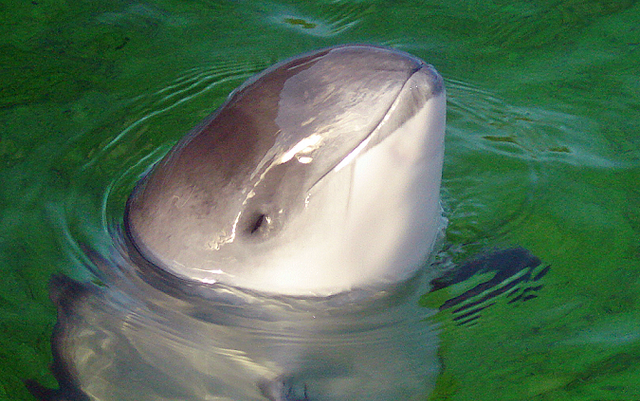
The Baltic Sea is home to three seal species and one whale species: the harbour porpoise, critically endangered and uniquely vulnerable. Unlike seals porpoises use echolocation for hunting- they emit calls and listen to their echoes that bounce off of nearby objects and return. This sensitivity makes them particularly susceptible to pile-driving noise.

Exposure can deafen, disorient, and stress porpoises and seals, driving them as far as 20 km from construction sites. Leaving their hunting grounds wastes a lot of energy and can lead to starvation.
The harbour porpoise population in the Baltic Sea has already been in decline for decades due to hunting, bycatch, and toxins. This continuous history of harm and disturbance with the addition of noise have collectively contributed to the shortened lifespan of native porpoises. Even though the harbour porpoises can normally live over 20 years, in the Baltic females often survive only 4 and males 6 years.
Harbour porpoises are top predators in the Baltic Sea, and their presence is vital to ecosystem balance. They manage the food chain’s structure and act as health indicators of the whole sea. Their disappearance would mean more than the loss of a species—it would signal the collapse of resilience in an already fragile sea.
The innovation
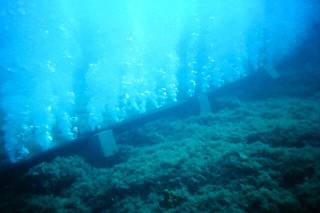
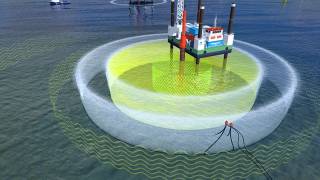
The Big Bubble Curtain, developed by Hydrotechnik Lübeck with support from Germany’s Ministry of Environment, offers a solution. The technology behind the bubble curtain is also used in sediment, oil and jellyfish barrier establishment. A flexible hose placed on the seabed releases compressed air, forming a rising wall of bubbles—like a giant underwater jacuzzi—around construction sites. Sometimes even two rings of the bubble veil are used for higher efficiency.
The idea behind the bubble curtain is to reduce the noise by disrupting the journey of the sound wave when it travels through the bubble wall. The sound waves are broken several times, as they pass through, and according to monitoring results noise is reduced by up to 20 dB, a dramatic decrease in intensity. Since 2008 this invention is continuously being implemented worldwide during pile-driving for wildlife protection efforts.
Results
Wind farm developers increasingly adopt bubble curtain technology to comply with their national noise pollution regulations. According to the sound measurements the noise is significantly reduced, but it is difficult to assess the result this has had on the animals, because harbour porpoises in the Baltic Sea have already been disturbed and endangered for decades. As mentioned before, there are multiple factors which harm porpoises, and even mitigation measures like bubble curtain deployment can add minor disturbances. Much remains to be done to safeguard Baltic wildlife beyond wind farm construction.
The philosophy
The Big Bubble curtain is not only an innovative solution- it is a symbol of care. One could argue that the noise produced by the pile-driving is a small price to pay for renewable energy, since climate change poses an even greater threat to marine life. By that logic the protection of the native seals and porpoises might seem unnecessary.
Yet this is exactly where the bubble veil becomes more than a clever trick- it represents the refusal to settle for inevitable harm towards the marine wildlife. Instead of accepting their disturbance as an unavoidable byproduct, we invent and implement ways to soften the blow. This is where the philosophy echoes the ideas of regenerative structures- rather than striving for a net-zero result and try to cause no harm, they aim to leave the ecosystem better than before. The Big Bubble curtain is not regenerative itself, but it carries a similar spirit: the belief that we can always refine our actions, do better and look for ways to protect life at every scale.
The binary choice between energy development and wildlife protection is an illusion and a limiting belief- the conservation efforts of the bubble veil represent hope for a future where human development and ecological health can coexist in harmony.
Alise O.
References:
- HELCOM. (2019). Noise sensitivity of animals in the Baltic Sea. Baltic Sea Environment Proceedings No. 167. Retrieved from https://helcom.fi/wp-content/uploads/2019/12/BSEP167.pdf
- Itämeri.fi. Porpoise. Retrieved from https://itameri.fi/en/nature-and-how-it-changes/species/marine-mammals/porpoise/
- Paddison, L. (2023, November 6). The big bubble curtains protecting porpoises from wind farm noise. BBC Future. Retrieved from https://www.bbc.com/future/article/20231106-the-big-bubble-curtains-protecting-porpoises-from-wind-farm-noise
- Wildlife Nomads. Types of porpoises family. Retrieved from https://www.wildlifenomads.com/blog/types-porpoises-family/
- Hydrotechnik Lübeck. Compressed air hydro sound mitigation. Retrieved from https://www.hydrotechnik-luebeck.de/portfolio-items/compressed-air-hydro-sound-mitigation/
- AVampireTear. Daan Close Up [Photograph]. Wikimedia Commons. https://commons.wikimedia.org/wiki/File:Daan_Close_Up.PNG
- Hydrotechnik Lübeck GmbH. (2013). Big Bubble Curtain Prototyp [Photograph]. Wikimedia Commons. https://commons.wikimedia.org/wiki/File:Big_Bubble_Curtain_Prototyp.jpg
- Evers, W. (2013). Big Bubble Curtain Schalldämpfung [3D illustration]. Wikimedia Commons. https://commons.wikimedia.org/wiki/File:Big_Bubble_Curtain_Schalld%C3%A4mpfung.jpg




Comments