

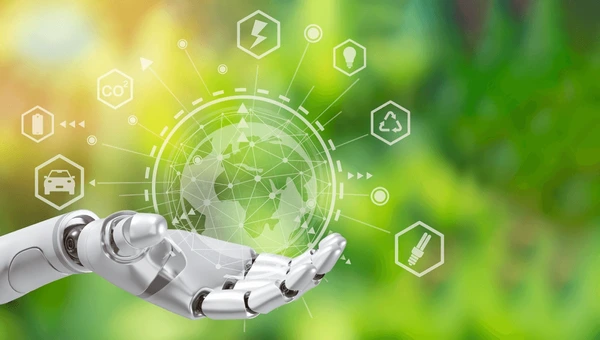
Why AI Matter in Environmental Conservation
Tradionally we take data colletion and evaluation manually,which so much time consuming and have prone to errors.But now we can use AI to process database massively, to identify patterns,enables faster and more accurate decision making.This is important for addressing complex environmental issuses that require real time response.
Application of AI in Conservation
- a) Wildlife Monitoring and Protection
AI-powerd image recognition systems are being used to track endangered speciers through camera traps and drones.For example ,organizations like WWF use AI to analyse thousands of omages to identify animal and detect poaching activities.
- b) Climate Change prediction
Machine learning models can predict extreme weather events and long-term climate trends by analyzing historical and real-time data.This helps governments and comunities prepare for diasasters and adapt to changing condition.
- c) Pollution control
AI algorithms can monitor air quality using sensor data.They can detect anomalies,predict pollution spikes, and suggest mitigation strstegies.For instance,AI -driven systems in smart cities help reduce air pollution by optimizing traffic flow.
- d) Sustainable Agriculture
AI supports precision farming by analyzing silo helth,crop conditions and weather patterns .This reduce resource waste and promotes sustainable practices,ultimately lowering the envirnmental footprint of agriculture.
- e) Smart Resources Management
Environmental engineering usually involves in reducing complex system with Competing demamds balancing water uses between agriculture ,urban needs and ecosystem health or managing land use to support both human communities and wildlife.AI is uses to analyse multiple variables and optimize that challenges.
Smart water management system use AI to predict demand ,detect leaks and optimize distribution,reducing waste etc.In agriculture ,AI powered farming minimize water and pesticides use while maintaining crops yields ,reducing environmental impacts.Urban planning tools incorporate AI in different scenarios affect local ecosystems,air quality and carbon emissions.

Real-World Success Stories
a camera trap in the Amazon rainforest captures thousands of images daily, but instead of researchers spending months manually sorting through them, an AI system identifies each species in seconds.
Google’s Wildlife Insights Project
Google partnered with several leading conservation organizations to build a project known as Wildlife Insights, which is a web app that enables people to upload, manage, and identify images of wildlife from camera traps. This platform democratizes AI-powered wildlife monitoring, making advanced technology accessible to conservation groups worldwide.
The project has processed millions of images, helping researchers track species populations across multiple continents and providing crucial data for conservation decision-making.
Microsoft’s AI for Earth Program
Microsoft’s AI for Earth program has developed tools that use computer vision to identify and count animal species from images captured by camera traps. The program has supported numerous conservation initiatives, including projects focused on endangered species like beluga whales in Alaska.
WWF’s Eyes on Recovery
WWF’s Eyes on Recovery project, in collaboration with Google, uses AI to analyze camera trap data, aiding post-fire wildlife recovery efforts in Australia. This initiative demonstrates how AI can help assess ecosystem recovery after natural disasters.
Protecting Siberian Tigers
The collaboration between World Wildlife Fund and Trailguard AI focuses on safeguarding Siberian tigers in China. Using AI-driven analysis of extensive data from camera traps, the project aims to enhance monitoring efforts and protect these endangered species.
Challenges and Limitations
Despite these benefits, the it highlights that bias and inequity in AI systems also present serious risks. If algorithms are not designed inclusively, they can perpetuate social inequalities and undermine trust. Additionally, the energy and water consumption of AI systems raises sustainability concerns, particularly in regions already facing resource constraints.
The paper also warns that many developing countries face significant barriers to adopting AI-driven climate solutions. Limited digital infrastructure – including unreliable internet connectivity, inadequate computing power, and capacity shortages – hinder the effective deployment of AI systems.
Moreover, developing countries often lack access to high-quality, comprehensive climate data essential for training AI models and supporting robust, data-driven decision-making. Without reliable data-sharing frameworks and cybersecurity measures, AI outputs can be inaccurate or vulnerable to misuse.
The Future of AI in Environmental Conservation
The future trends in Artificial Intelligence (AI) for environmental conservation are increasingly becoming a focal point of interdisciplinary research, aiming to harness AI’s potential to address pressing environmental challenges. This exploration delves into the sustainable application of AI in environmental economics and management, its role in scientific discovery for a sustainable future, and the mitigation of heavy metal pollution, highlighting the transformative potential of AI in fostering environmental resilience and advancing sustainable practices.
Lobova, Bogoviz, and Alekseev (2022) provide a comprehensive analysis of sustainable AI’s role in environmental economics and management, particularly in the context of the post-COVID-19 era. Their study emphasizes the critical importance of AI in studying its impact on ecological economics, highlighting the need for sustainable AI as smart technology to maintain stable and balanced economic systems. The research underscores the potential of AI to address current environmental threats while cautioning against its limitation in preventing future crises. By advocating for a broader application of sustainable AI beyond immediate healthcare needs, the study presents a forward-looking perspective on leveraging AI to ensure long-term environmental sustainability.
Gomes (2023) discusses AI’s contribution to scientific discovery and its pivotal role in advancing sustainability. Focusing on the interdisciplinary field of Computational Sustainability, Gomes highlights how AI can help balance environmental, economic, and societal needs for a sustainable future. Through examples ranging from biodiversity conservation to renewable energy materials discovery, the keynote underscores AI’s capacity to accelerate scientific breakthroughs that could significantly impact sustainability efforts (Ninduwezuor-Ehiobu et al., 2023).. This perspective illuminates the vast potential of AI in contributing to a sustainable future through innovative research and applications (Gidiagba et al., 2023).
Conclusion
Artificial intelligence represents a powerful new tool in the environmental engineer’s toolkit, offering unprecedented capabilities for monitoring ecosystems, predicting environmental changes, and optimizing conservation strategies. From protecting endangered species to combating climate change, AI is already making tangible contributions to environmental conservation worldwide.
However, we must approach this technology thoughtfully, recognizing both its potential and its limitations. AI works best when integrated into comprehensive conservation strategies that value local knowledge, engage communities, and address the root causes of environmental degradation. The energy and resource costs of AI itself must also be considered and minimized.
As environmental challenges grow more complex and urgent, the marriage of artificial intelligence with environmental engineering offers genuine hope for protecting our planet’s precious ecosystems. By harnessing AI’s analytical power while maintaining our commitment to equity, sustainability, and community-centered conservation, we can create more effective and resilient approaches to environmental stewardship. The future of conservation is not about choosing between technology and traditional methods it’s about intelligently integrating both to achieve outcomes that neither could accomplish alone.
https://www.wildlifenomads.com/blog/conservation-ai-artificial-intelligence/
https://www.wildlifenomads.com/blog/conservation-ai-artificial-intelligence/
References
- WWF. AI in Wildlife Conservation. https://www.worldwildlife.org
- Google AI Flood Forecasting. https://ai.google
- Microsoft AI for Earth. https://www.microsoft.com/en-us/ai/ai-for-earth
- Nature Journal: Artificial Intelligence for Environmental Monitoring.

Comments