Performing arts have the potential to critically subvert and transform the established meanings of different urban spaces. Mary Flanagan (2009, see also Lundman, 2012) has written about critical play in relation to the urban space, by which she means introducing artistic and playful movement, objects, and performances in everyday public spaces in an interventionist fashion, thus opening new kinds of societal or political dialogues and ‘transgressing the boundaries between art and everyday life’ (9).
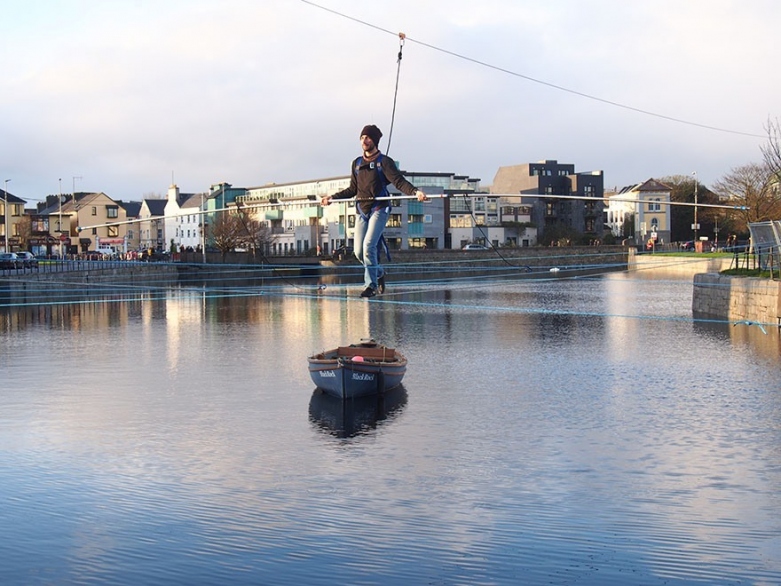
In his keynote talk, Dr, lecturer Ian R. Walsh from the University of Galway talked about Galway Community Circus’s LifeLine/Wires Crossed event, organized in Galway on 16 July 2022. During the event, 150 people of all ages and backgrounds crossed the River Corrib on a high wire. The site on the river where the performance took place is one where suicide is prevalent, and thus, the event aimed to reinfuse hope into a space that carries great sadness and beauty.
This event highlighted the possibilities of artistic expression, exemplified by circus, to create new meanings and address complex and difficult topics in the public space. The event was met with high attention from both the audience, as twenty thousand spectators gathered along the river to enjoy the performances, and from the media. One example of the media attention was an article published in the Irish Times, quoting the leader of Galway Community Circus, Ulla Hokkanen:
It seemed very bad in 2016 […] I was living beside it, and it was constant. Every week, there was another death. You would hear the helicopters, and everyone who lives in Galway knows what that means: that someone has jumped into the river and the helicopters are looking for them […] We thought about this idea of trying to address youth mental health and wellbeing through circus. We are not trained mental-health experts, but with community projects, like circus, we can help create a preventive space, a safe space, for young people to overcome challenges and support themselves and each other. (Keating 2022)
While these events demonstrated transforming potential in the public perceptions of wellbeing in the urban space, Walsh also highlighted critical aspects included in these kinds of urban art projects. It is highly important to be wary of, firstly, the well-being of the participating artists and, secondly, not reducing the understanding of performing, urban arts to wellbeing benefits only. This is especially crucial in our current time, where public funding for performing arts is diminishing. As Norma Daykin (2019) has argued, ‘[t]his can lead to a skewing of research agendas towards outcomes and benefits of arts, rather than the adoption of a more exploratory approach that examines both positive and negative aspects or is open to the discovery of unintended outcomes’ (48).
Circus as a research method
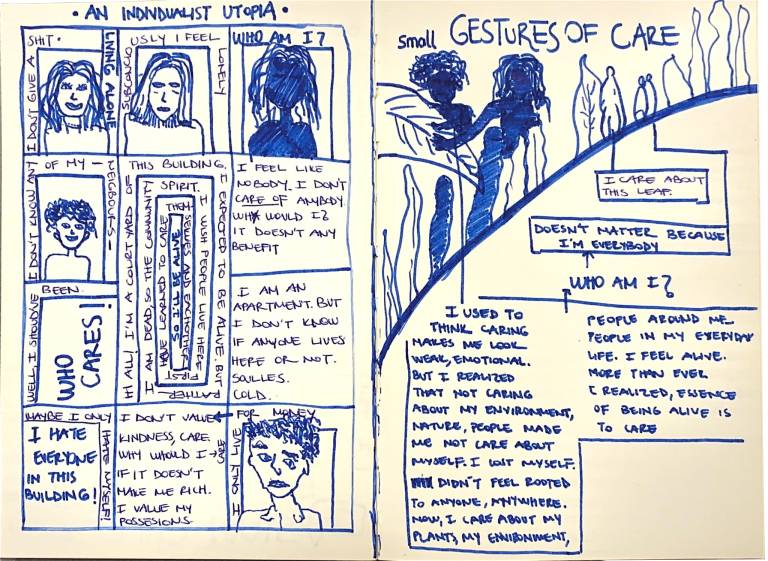
Following feminist philosopher Minna Salami (2019), academic knowledge production often ignores knowledge perceived through the senses, as well as the emotional and non-verbal aspects of expression. Using art-based, creative methods in different research setups provides a way to explore and challenge the boundaries between (social) research and art and widen the perception of knowledge (Perheentupa & Porkola, 2024).
In the second talk, Ilaria Bessone (AltroCirco, Italy), Heta Mulari (Tampere University), and Ian R. Walsh talked about their experiences of using art-based and embodied methods in the research-evaluation project Circus TransFormation Advanced (2021-2023). Coordinated by Tampere-based Sorin Sirkus and in collaboration with several European social circus organizations and the Caravan International Youth and Social Circus Network, the project evaluated an international training programme for social circus trainers.
During the project, the researchers applied several creative methods, including photo elicitation in focus groups and Tableau in theatre-based workshops. Further, they introduced circus as a research method, including a workshop where the participants explored their experiences of the training programme through movement with circus props, creating a performance, as well as written and verbally shared reflections. In the discussion, the participants commented that the embodied, movement-based reflection made them “remember and realize some stuff”, and that “reflecting things through movement gives some kind of honesty, you are kind of forced to be honest to yourself, and it’s hard to hide”.
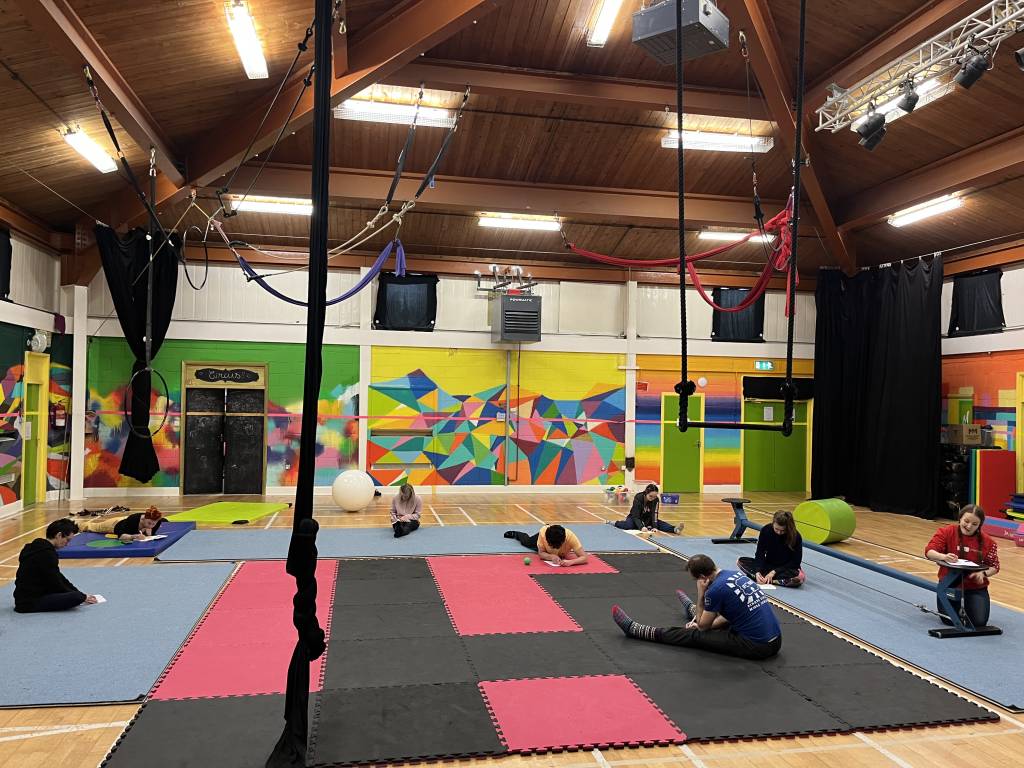
As demonstrated through this example, art-based and embodied research methods may provide ways of accessing a wider range of perspectives than traditional research methods, via experiential and alternative ways of knowing, including aspects (multisensory, physical, corporeal) of life that cannot otherwise be observed.
Academic room as a circus space
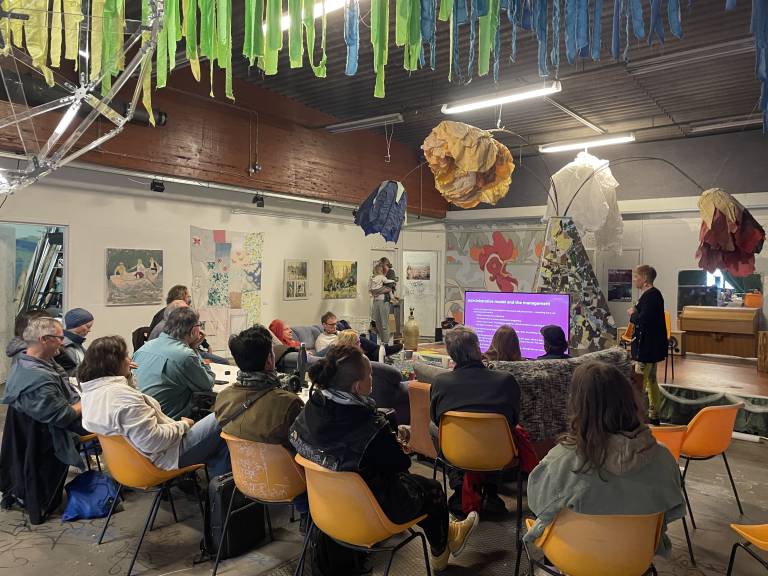
During the symposium, the participants were also invited to express their feelings at that particular moment with different circus props and movement in a workshop facilitated by Ilaria Bessone. In this exercise, the space seemed to transform from an ordinary university seminar room to a circus space with colourful props, movement, loud speaking, and laughter.
The workshop demonstrated the possibilities of performing arts in exploring and transforming our understandings of both the space as well as conventional, embodied, and academic choreographies.
We are looking forward to continuing these experiments and discussions in, for example, the newly established international academic network for social circus research. Many thanks to TURNS seed funding for making the event possible, and to all speakers in both morning and afternoon sessions.
Ilaria Bessone holds a PhD in Sociology and Methodology of Social Research (University of Milan). She is a circus teacher and a social circus trainer of trainers. She is also the research coordinator of AltroCirco – a project for the development of social circus in Italy – and collaborates with circus organisations and international networks.
Heta Mulari is a post-doctoral researcher at the Faculty of Social Sciences at Tampere University. She identifies as a youth researcher, research topics covering creative urban (sub)cultures, film and digital media, as well as qualitative research methods.
Ian R. Walsh is Lecturer in Drama and Theatre Studies at the University of Galway. His books include: Contemporary Irish Theatre: Histories and Theories, co-written with Charlotte McIvor, and Experimental Irish Theatre: After W.B. Yeats. Co-edited collections include: Cultural Convergence: The Dublin Gate Theatre, 1928-1960, The Theatre of Enda Walsh.
References
Bessone, I., Mulari, H., & Walsh, I. R. (2024). Circus Transformation Advanced: Research Report on the Impact of Circus Training for Trainers Programmes. Caravan Circus Network. https://www.caravancircusnetwork.eu/youngcaravan/research/
Daykin, N. (2019). Arts, Health, and Well-being. A Critical Perspective on Research, Policy and Practice. London: Routledge.
Flanagan, M. (2009). Critical Play: Radical Game Design. Cambridge: MIT Press.
Keating, S. (2022). Thrown a LifeLine: ‘Every week there was another death. Everybody was asking the same thing: What can we do about the river?’ Irish Times 2.7.2022.
Lundman R. (2012) Kaupunki leikkikenttänä. Kriittisen leikin ja kaupunkitilan vuorovaikutteisuus Turku365-hankkeessa. Alue ja Ympäristö 41(1): 3–13.
Perheentupa, I., & Porkola, P. (2024). Stimulating Political Imagination With Arts-Based Methods: The Case of Utopia Consultation. Sociological Research Online. https://doi-org.libproxy.tuni.fi/10.1177/13607804241286416