

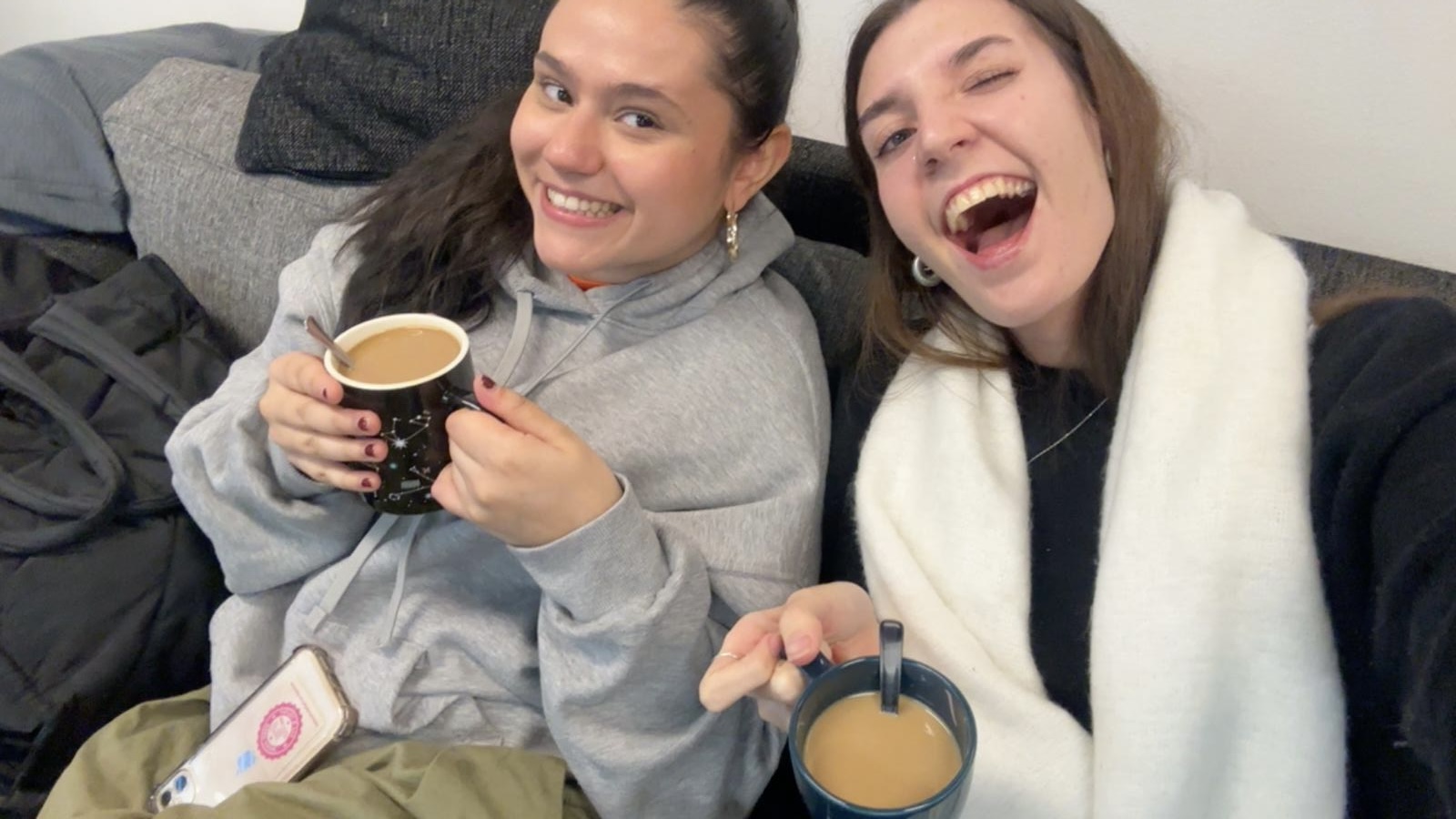
Even though this meeting was not centred on English practice, it still supported the learning goals of our project. By sharing cultural traditions entirely in Spanish, we were able to explain them in a richer and more detailed way. I learned more about Aragonese traditions such as dancing jotas on important holidays, and I shared aspects of Andalusian culture, especially flamenco, its origins, and its importance for me, because I’ve been a dancer my whole life.
Speaking in Spanish also helped us reflect on how language influences our ability to describe cultural identity. Some concepts simply feel more authentic or precise in one’s native language and this session highlighted that.
During the second part of the meeting, still in Spanish, we exchanged information about the courses we are taking this semester at TAMK. We also compared how course validation works in our home universities. Although we did not practise English or French this time, the conversation still required us to communicate complex academic ideas clearly and coherently.
This meeting showed me that language learning is not only about constant practice of the target language, but also about understanding why we choose certain languages for certain topics. Speaking Spanish created a comfortable space for discussing deeper cultural aspects. When describing traditional dances, music or regional identity, Spanish gave us the emotional and cultural terminology that English sometimes lacks.
Reflecting on my own culture in detail also helped me realise how much cultural knowledge I take for granted. Explaining it to someone from another part of Spain (who shares the language but not the traditions) made me think more critically about what defines Andalucía and what part of that identity I carry with me abroad.
Since we spoke Spanish throughout the entire meeting, we did not achieve any of our language-practice goals for English or French. We had originally planned to maintain English as the main communication language, but cultural topics naturally pushed us to switch to Spanish.
There were also moments when explaining the academic validation systems became complicated, because university procedures are difficult to summarise clearly.
We realised that some cultural content is better expressed in the mother tongue, and that this does not contradict the overall goals of the project, it simply adds a more personal perspective.
Discussing our Erasmus courses and how they will be validated was not an original part of the plan, but it became an important academic exchange. It helped both of us understand our study programmes better, which is also valuable in our experience abroad.

Comments