My fingers grasp the red crayon as I push it into the paper, drawing a singular, continuous line. I lift my gaze as she lifts hers; our eyes meet for a fraction of a second before we both look away. Perhaps there’s a chance? Perhaps there’s a chance that this is the twin soul I’ve been looking for? My hand moves closer, drawing my line nearer, curving it towards her. Will she respond in kind? Her line, a dark blue, slides ever so slightly closer. Our lines curve away before yet again coming closer together, our hands now mere inches apart. I have to take this chance, I think as I curve my red line into her blue one. Our paths cross as our crayons race each other on the paper, my hand brushing against her palm. I look up once more, just to check. She nods. That’s it. My crayon swirls around to hers, our arms making skin-to-skin contact; our movements align like two bodies dancing together, tracing each other’s steps in waves, then circles, then waves again. Suddenly, her hand is over mine, as mine leads the way and her other hand reaches over to grasp my arm gently. I grasp hers in return, feeling hope in my chest. Will this be a brief dalliance, or perhaps something more?
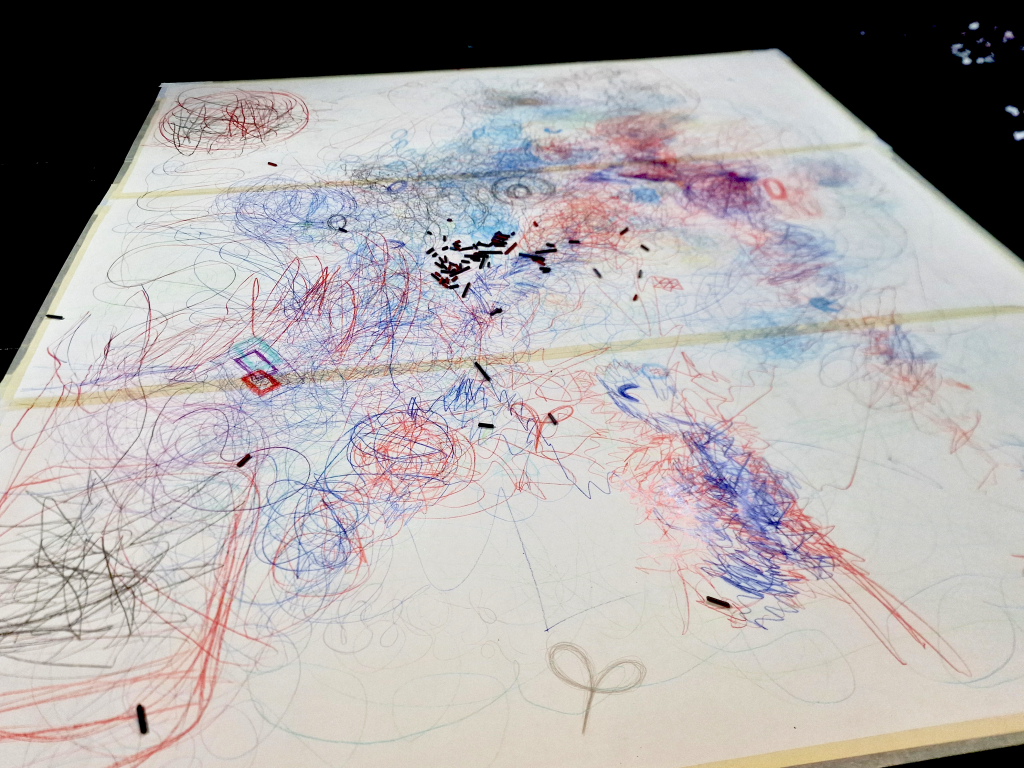
In my head I’m Sigrid Hedman, a closeted masculine lesbian, who has five children and is married to a man… but in reality, I’m very much feminine, unmarried, and have no children. I’m taking part in something that the creators Nina Mutik & Vili Myrsky Nissinen call an “instruction-based participatory performance,” set up in the middle of a theatre room at a games and arts festival over the weekend. I’m crouched on top of large sheets of paper, which are taped together on the floor, while holding a crayon and drawing a continuous line with other people around me who are doing the same. We are all characters in a play-like performance. A performance based on real people, real events, and real feelings.
Hilma af Klint and The Five
Hilma af Klint was a respected Swedish artist who lived between 1862 and 1944. Contemporary readings of her diary entries suggest she may have been queer or non-binary. This has never been confirmed. What is known, however, is that she created many paintings and became a successful artist, with her works now featured on the websites of the Museum of Modern Art (MOMA) and the Guggenheim New York. Even so, during her time, she hid what she referred to as her “great work,” or her personally important work, because according to her, the world was not quite ready for the message these pieces intended to communicate. She feared their messages and meanings would be lost to viewers (Willsher, 2026). As per her instructions, these paintings were only allowed to be unveiled 20 years after her death.
What were these paintings? While studying at the Academy of Fine Arts in Stockholm, she and four other women had come together to explore what the Hilma af Klint Foundation calls “spiritual realms through meditation and séances.” These five women were af Klint, Anna Cassel, Cornelia Cederberg, Sigrid Hedman, and Mathilda Nilsson, who between 1896 and 1908 began communicating with higher beings in trancelike states, while recording messages through “automatic writing and drawing.” In short, making art while connecting spiritually to something far beyond.
This form of psychic mediating, while painting, came to produce af Klint’s most personally treasured work. The other four women also produced art and sketches, though none of them rose to the same level of recognition that af Klint did. But together they became known as The Five, whose methods of creation inspired the performance I took part in.
Inner Domain
Inner Domain is the name of this instruction-based participatory performance. It combines live-action role-playing (larp), theatre, and visual arts in order to encourage participants to live out the roles and relationships of one of The Five, while exploring their own bodies, genders, sexualities, and erotic lesbian tension. According to Mutik & Nissinen’s interpretation, The Five were all lesbians, or at least queer, and looking for connections and romance through spiritual practices. It should be noted that this fact isn’t acknowledged by the official foundation of Hilma af Klint, though it is a theory that circulates in the art world.
Through Inner Domain, however, in this embodied, artistic experience, Mutik and Nissinen hope to create a safe space for people to explore gender norms and same-sex romance while channeling a time when feminine roles in society were closely defined. Due to the performance being non-verbal, all communication between participants happens through the physical: touching and drawing in a way that Mutik describes as “sensual, fragile, erotic, and emotional” (Mutik, 2025).
My Review
This was my second-ever larp experience, but it was a pretty memorable one and drastically different from my first. The session started with a workshop, which began with us breaking the touch barrier with all the other participants as we walked around shaking everyone’s hands. We then practiced nonverbal communication, as well as requesting consent, all through eye contact and body language. We were encouraged to practice both accepting and rejecting communication using our bodies as mediums to convey information. The gestures needed to be big, visible, and obvious, as this was vital for the journey that was to come.
Each participant chose a specific painting made by af Klint, which the organisers had selected and assigned to represent each of the women in The Five. By choosing our favourite painting, we were choosing a character to channel for ourselves. I chose a warm-coloured painting with a somewhat heart-looking shape in the middle, as well as a rainbow below it: “Group IX/UW, the dove, no 2.” This was Sigrid Hedman, a psychic leader and a dominant woman in her 40s, who was a very skilled medium. She used her chance in The Five to explore both her spirituality and her sexuality as a closeted lesbian in a heterosexual marriage. Although she explored new romantic connections with her peers, she wasn’t one to commit. My interpretation of her was that her participation in these seances was escapism, something that I identified with, as someone who uses games and play as an escape from the real world myself. In the end, whether she chose me or I chose her, I cannot say.
The performance itself was a mixture of rituals in succession, for which we were provided instructions. There were three scenes or “parts” to the play, each one beginning with a Bible reading at an altar with flowers, a candle in a lantern, and some stacked tablecloths. One of the participants in each scene stepped up to read the verse, something that mimicked the way The Five practiced seances. This was followed by a moment of silence, where we contemplated our characters and their motivations in the scene to come. Before our ritual was complete, however, we also chanted while standing in a circle and holding each other’s hands.
It was at this point that we crouched down to pick up our crayons and began drawing each of our character’s own symbols, perhaps as a way to contact our characters’ spirits. Thus began the meditation, the continuous line, the searching for our character’s twin soul, who they are meant to be with, their other half. There were dalliances, rejections, drama, jealousy, sisterhood, and aggression portrayed, all without anyone uttering a single word. Music played through each of the scenes, with proper theatre lighting reflecting the changing mood.
Regardless of who you were in real life, during the scene you were a lesbian in the 1900s. Me, or rather my character Sigrid, fell in love twice, though she was unable to commit to her lover. This caused tension and betrayal in her relationships. Between scenes, we also drew portraits of our first love, the player rather than the character, then symbolically ripped the portrait apart in jealousy in the next scene when our characters had moved on to different relationships. The women were complex, nuanced, flawed, but beautiful, and the participants held hands, grabbed each other’s arms, aggressively broke up other couples, or tried to. I even broke a crayon in the tension of it all, which symbolically became part of my character’s story. All this while drawing lines on a paper, in the name of queer love.
The performance was beautiful, tragic, and strange. I walked away with a story in my mind, yet not a single word had been exchanged. The tension in each scene heightened, the last being the most dramatic. The embodiment of the character made the feelings feel real, as if it was play but it simultaneously also wasn’t. It was an experience that I’ll never forget, something I’ll probably never experience again. What happens in The Five, stays in The Five.
Bibliography
Hilma af Klint Foundation. (n.d.). About. Hilma Af Klint Foundation. Retrieved October 28, 2026, from https://hilmaafklint.se/about-hilma-af-klint/
Inner domain – viirus. (2025, October 31). Viirus.Fi. https://www.viirus.fi/en/shows/inner-domain/
Mutik, Nina & Vili Myrsky Nissinen. 2025. “Larp As Embodied Art.” In Anatomy of Larp Thoughts, a breathing corpus: Knutepunkt Conference 2025. Oslo. Fantasiforbundet.
Muñoz-Brenes, T. (2024) A queer woman pioneers abstraction: Hilma Af Klint 80 years after her death – artishock revista, Artishock Revista. Available at: https://artishockrevista.com/2024/10/21/hilma-af-klint-80-years/ (Accessed: November 7, 2026).
Willsher, K. (2026) Who was Hilma? Af klint exhibition to highlight exclusion of women from abstract art, the Guardian. The Guardian. Available at: https://www.theguardian.com/artanddesign/2026/apr/10/who-was-hilma-af-klint-exhibition-to-highlight-exclusion-of-women-from-abstract-art (Accessed: November 7, 2026).