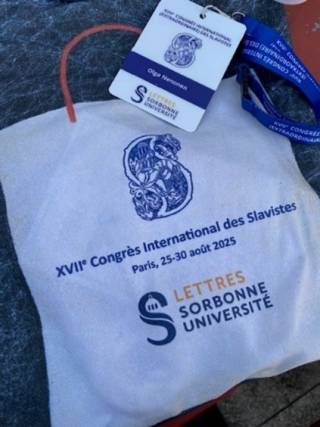
The International Slavists’ Congress gathers together slavists from around the world. Traditionally, it has been organized in one of the Slavic countries. The Russian war in Ukraine has been a great shock also to the slavists’ research community, and because of it the Slavists’ Congress was postponed and is finally taking place now in 2025 instead of 2023. This year’s congress, organized in exceptional circumstances and for the first time not in a Slavic country but in France, is thus called extraordinaire. For the first time in its history, many distinguished researchers from Ukraine, Belarus, and Russia have not been able to participate. The motto of the congress has become Cicero’s words: Cedant arma togae, presented in translations into ten Slavic languages. The congress is traditionally very large; this time, representatives from 43 countries have gathered.
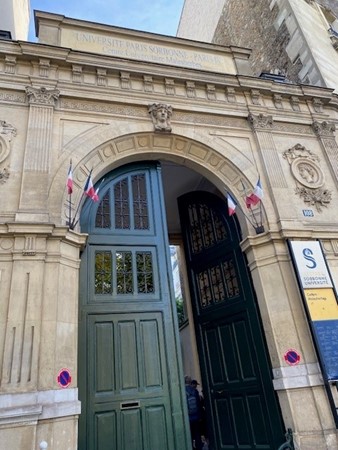
The first day of the congress, 25 August, was inspiring: a great number of participants gathered for the opening ceremony in the Grand amphithéâtre of the Centre Malesherbes, Sorbonne University (Le Congrès est organisé par la faculté des Lettres de Sorbonne Université et l’Institut d’études slaves en partenariat avec Eur’Orbem et le CELISO). We listened to four plenary talks, the highlight being without doubt the lecture by the famous Russian writer Boris Akunin. He spoke about history and anxiety, about his own journey from writing “lightminded” detective novels to creating major historical overviews—meaning his recent ten-volume work The History of the Russian State.
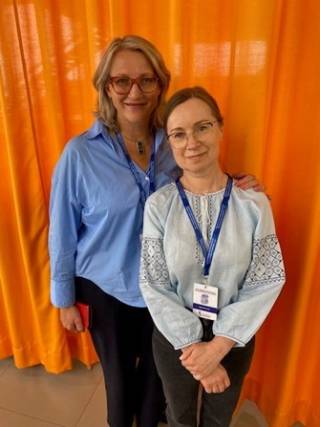
The second day of the congress, 26 August, included 44 sections, making the choice of topics far from easy. The most inspiring talks for me came from the section on formal and functional syntax, comparing Russian, Ukrainian, and Belarusian corpus data on distributive bi-pronominal constructions and lexical repetition in East Slavic languages (Apresyan Valentina, Kopotev Mikhail). The section on linguistic politeness La politesse linguistique / Языковая вежливость also gave valuable insights into questions of pragmatics I am interested in for both teaching and research: explicit and implicit politeness, speech etiquette in Slavic languages, negative and positive politeness, and politeness in different types of discourse. Finally, the sociolinguistic session provided the talks I had been most looking forward to. It explored the impact of war on languages—for example, language contact, language shift (from Russian to Ukrainian), and language conflicts (in Ukraine and Russia). At the end of the day, I attended the talk I anticipated most: Necrolangue / NecroSpeak / Некроязык: The New Russian Language Policy, 2022–2024 by the well-known anthropologist and linguist Alexandra Arkhipova. She analyzed the language of war created in Russia. The topic is very timely and something we often discuss with students; in fact, it has been popular among students writing their bachelor’s dissertations.
The third day, 27 August, featured 41 sections and round tables. For me, the main topic of the day was “Plurilingualism.” There was a broad discussion of minority languages in different countries as well as many other aspects of multilingualism. I also presented my research, Lexical Gap-filling Strategies in Heritage Speakers of Russian in Finland, exploring data from adult and child heritage Russian speakers with dominant Finnish, as well as strategy changes from childhood to adulthood.

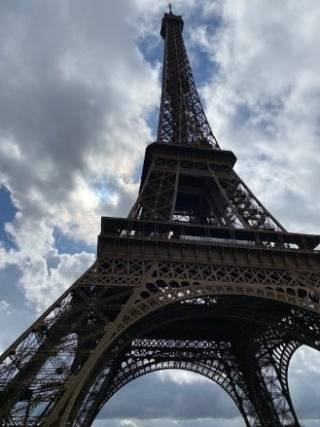
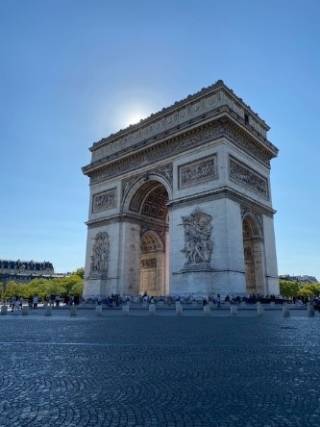
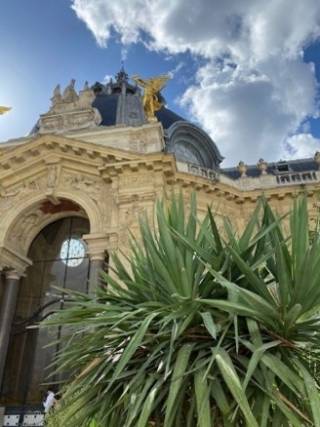
The fourth day, 28 August, titled Réunion du MKS, was dedicated to meetings of thematic commissions with numerous specialized presentations. We were also encouraged to explore the lovely city of Paris, which I did with great pleasure. The city offered warm, golden late-summer days.
The fifth day, 29 August, was again intensive, comprising 40 sections and round tables. I chose the section on humor. The talks focused on the linguistic aspects of humor, humor as protest, social activism through humor, and “humor between the lines.” All these approaches confirmed that “humor is serious.”
The sixth and final day, 30 August, was shorter, with 12 sections and the closing ceremony in the afternoon.
To sum up what I took away from the congress: meeting friends and colleagues, networking, and enjoying the last moments of summer in the unique ambience of Paris and French culture. The congress gave me a great deal of inspiration for my work and opened new perspectives. It offered the unique feeling of diving into the world of Slavic languages, of being among other slavists, and of seeing how numerous we are. Slavistics indeed exists not only in Slavic countries but on every continent.