Every three years, the congress of The European Society of Translation Studies connects translation scholars from around the world. The 11th congress with the theme of ”The Changing Faces of Translation and Interpreting Studies” in Leeds, UK, from 30 June to 4 July 2025 was no exception. Five days, 50 thematic panels, more than 600 presentations and more than 700 attendees, several official meetings and many more unofficial gatherings provided many opportunities for taking stock on what is hot in translation and interpreting studies, and what might be bubbling under to become the source of next buzz.
Tampere is an active hot spot for forward-looking translation research. It is therefore no wonder the Tampere delegation consisted of no less than eight participants in varied roles ranging from panel convenor, presenter and poster presenter to meeting delegate for the International Doctorate in Translation Studies network. Some were first-timers in an EST congress, others seasoned delegates from the 1990s onwards. Below we all list our main impressions of the highlights of the congress. In a congress that spans ten parallel sessions for many days, selection bias unavoidably affected our impressions. We have, in many ways, all participated in a different event. The report therefore gives voice to several of us Tampere delegates.
What was hot?
It was the first time I participated to the EST but, as a translation conference, it felt quite forward looking. Many presentations at EST seemed to be either on the activist side (underlining how translation can be a tool of critique, how language is used as soft power etc.) or quite flexible in their approaches to translation (e.g. museums translating the cities they represent. (Mattia)
The implications of the war in Ukraine and the more than 5 million refugees that have fled Ukraine to Europe were to be seen, heard, and felt in many presentations and talks. The topic of the war and refugee crisis caught my ear across many panels and discussions, not only the ones dealing specifically with Ukraine or crises and conflicts in general. I think it’s perfectly understandable: a major war in Europe that is still unfolding is bound to influence translation studies on many levels for years to come. (Pekka)
Some EST conferences have been very focused on some predominant current theme (e.g. EST 1998 on Venuti’s theories; EST 2001 on corpus research). I did not see anything overwhelmingly dominant in Leeds, but the automation of literature was a hotter topic than I had realised. (Kaisa) — AI and MT were all over the place. (Mary)
One key moment was listening to Professor Hanna Risku’s keynote entitled “Distributed, Collective Enaction: Reframing the Study of Translation and Translation Expertise”, leaving my cognition with an impression of more future flexibility and dynamics between existing expertise models and understandings of translation competence and expertise. This flexibility, perhaps, can be manifested as different ways of emphasizing the nature of the translation task and its interdependence with different professional situations and expectations. I would like to foresee a growing interest in such a fresh way of perceiving translation expertise and an increasing intellectual motivation in exploring its constituents and their dynamic nature as well. (Maria Annukka)
What was bubbling under? What new insights did we get?
As can be seen from our reflections above, similar to many other (all?) fields of study, Translation Studies is currently reinventing itself and re-imagining its research objectives. This is a sign of a healthy and dynamic discipline. AI is a major contemporary disruptor, and its effects were seen, perhaps more constructively than anticipated, but the rethinking of the discipline went beyond that.
The tone was surprisingly positive in times of AI: despite (and also because) of AI, human expertise will be needed in future more than ever. The discussions I attended did not include any panic because of AI, on the contrary, the overarching idea was that there will of course be changes and we need to adapt and change ourselves and ways of work, but human expertise will be needed nevertheless. (Anu)
Translation studies seem to be alive and well and taking things in its stride. Mounting challenges to TS, such as the influx of AI/LLM and a receding liberalist and rules-based world order seem to be met calmly, sometimes even on a positive note. Overall, one could have expected (or predicted) more idealistic/activistic stances and alarmist tones at the conference. Of course, this is more of a gut feeling than an observation, let alone an analysis. (Pekka)
In a conference with so many tracks, many things are likely to be bubbling under. Two increasingly topical themes come to mind: translation and translationality understood in a wide sense is gaining ground, and autoethnography and embedded and engaged modes of research are becoming increasingly popular and accepted. (Kaisa)
Overall, I felt there was a desire to rethink the discipline in the face of AI. This goes beyond dealing with AI (which is hot rather than bubbling) and more about the “what then”. What can TS be in the world of the future? What are we able to do? What do we have to say? And this is why (in my mind, at least) activities and expansionist takes on translation are hot. (Mattia)
It’s still bubbling pretty far under (and attracting me for obvious reasons), but maybe a bit of a turn outward is lurking in the corners? Investigating non- and paraprofessional translation, translation in the wild, and AI translation use by non-translators. As early careerer Vicent Briva-Iglesias put it: “That’s where the interesting stuff is happening. And where we can make a real difference.” (Mary)
What will we remember EST 2025 by?
We will surely remember the architecture!
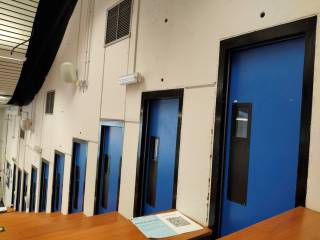
The Rogers Stevens Building felt like it was designed by Dedalus while drunk – but also had a nice playful vibe in its weirdness. The building was a nightmare at first (how to find the right room in time?), then a bit annoying (the doors were by far too heavy), and finally, when leaving, I noticed that I kind of missed the colourful doors and the odd system with missing levels/floors already.
We were also quite touched by the inclusive and kindhearted atmosphere despite the relatively large size of the event. EST2025 will be most memorable for all the collegial encounters and academic friendship. The sheer number of people everywhere was almost too much to bear in the Leeds heat wave, but it also enabled many happy reunions and also new acquaintances. The conference was big and bubbly and cozy and intimate all at the same time.
We gratefully acknowledge the financial support of Tampere University Languages unit, the University of Tampere Foundation, Emil Aaltonen Foundation and The Finnish Association of Translators and Interpreters (SKTL).