
AI in Social Sciences: Finding the Balance
(Claudia Åvist)
The university does have instructions on AI usage (Traffic light model: How to guide students in the use of AI). However, professors and students have quite different perspectives on how it should be applied in social sciences. Some, like myself, used to think we should not be using it at all, as it could impair learning and analysis in our field. Yet some used it a lot and had AI do most of their work. Now that the biggest shock from AI has passed, it seems that the implementation of AI has somewhat stabilized.
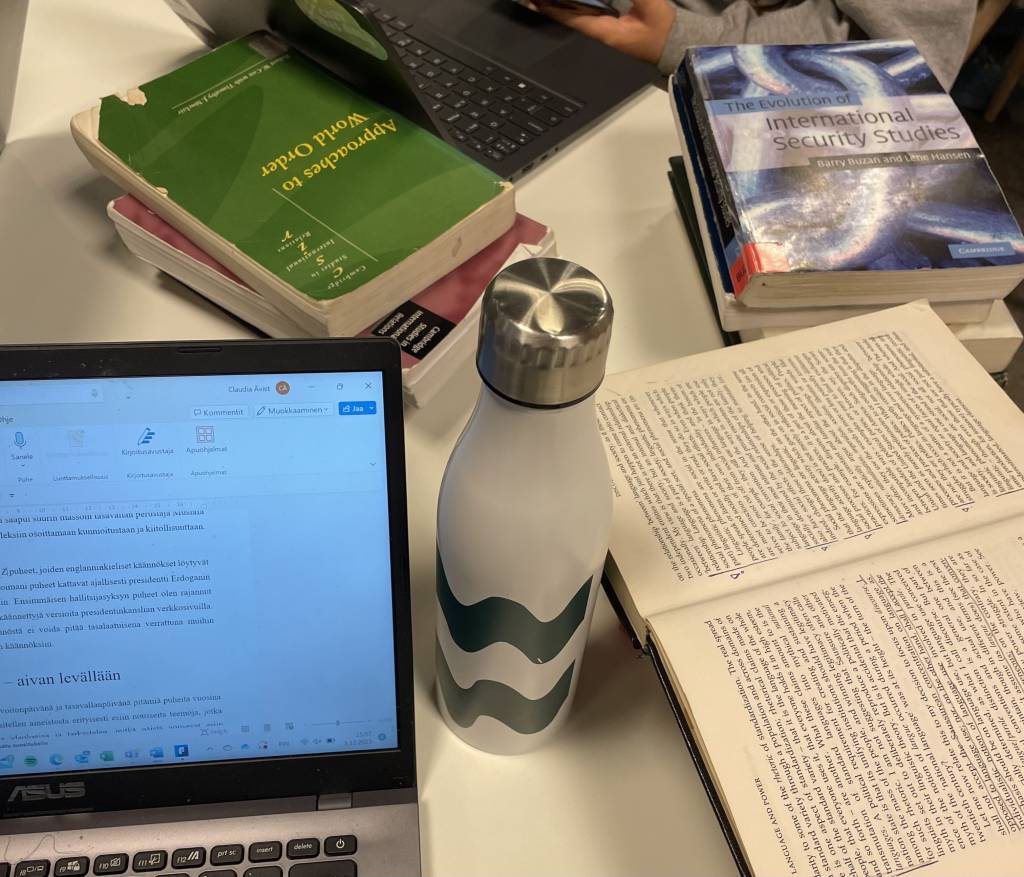
What I mean by this is that those who were more confrontational about AI have begun to understand its advantages, while those who seemed a little too naïve about it have recognized the disadvantages and negative impacts of AI.
Well, how do we use AI in social sciences then? From my own experience, I think it is a great tool for getting the big picture of completely new topics, similar to how someone might use a simple Wikipedia article to understand the broad lines of something new before diving into proper research on that topic. It is also a great tool for sparring with research topics and ideas for a paper, but you need to learn to ask the right questions. It can also be used to summarize papers, but it might leave out important nuances in the process, so I don’t recommend completely relying on the summaries.
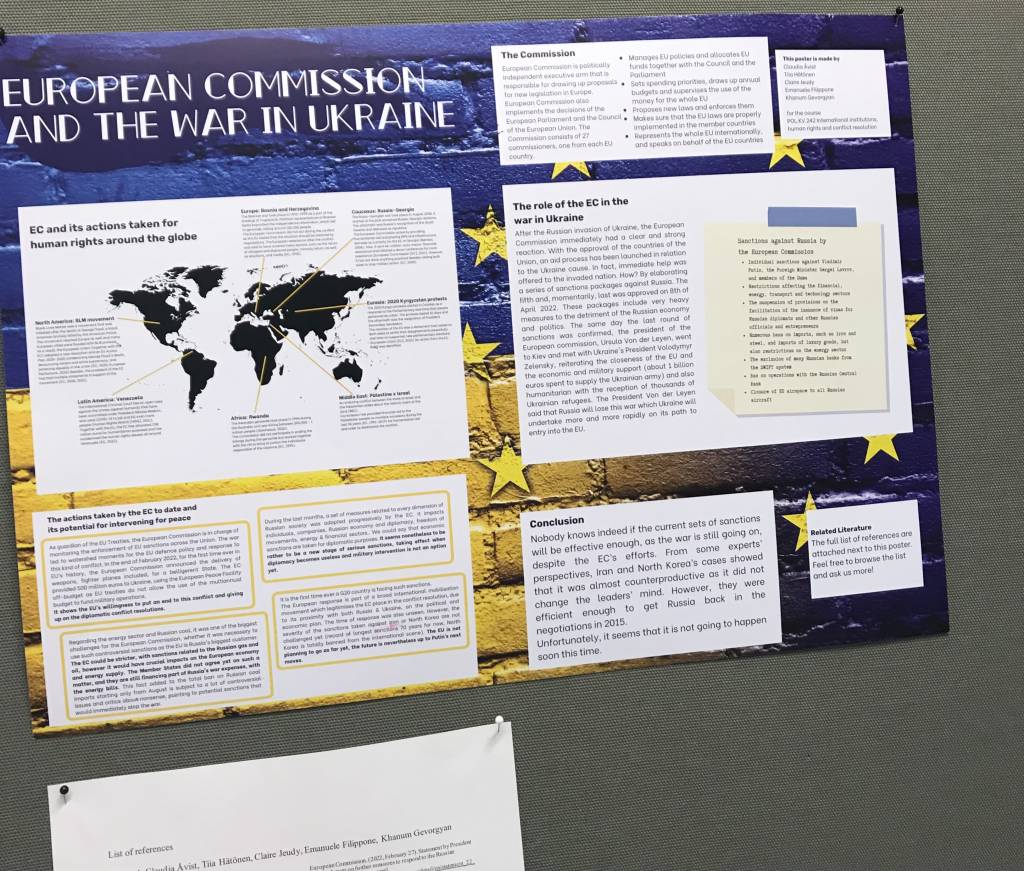
During a class this semester, we were encouraged to use AI in our portfolio project. My group used it to come up with research questions and to learn about new topics on the surface level. Another way we used AI tools was for transcribing. I am personally very skeptical of AI, but I must say that for transcribing, it is such a great tool. Of course, we still had to double-check the text, and the AI did make some mistakes, but it certainly made the work much easier.
Things that I would not use AI for are essay writing or writing and analyzing in general. This is exactly the point of our degrees in social sciences: to gather information, understand different topics and perspectives, gain knowledge of a topic of expertise, and analyze situations using that knowledge. However, if you are simply struggling to come up with better wording for a sentence or other small things, it can be used as a helpful tool to rephrase them.
I would also never use sources from AI without checking them first. AI might give you false sources that do not exist at all, or they could be incorrect in other ways. I would also never use it as the only source of information. It is great for grasping the big picture of new topics, but not for proper learning.
How I Use AI as an MSc Student in Data Science
(Anas Uddin)
As an MSc student in Data Science with a minor in Software, AI tools naturally find their way into my daily academic routine. But the keyword here is routine, not replacement. For me, AI is not something that does the work for me. It is something that helps me work better, faster, and more thoughtfully.
Image generated with Seedream 4.5 AI model by ByteDance.
At Tampere University, the use of AI is not simply ignored or banned. In many courses, we are encouraged to use it responsibly. Often, we are asked to report how we used AI tools in our assignments. At the same time, our exams are usually taken in an electronic environment without internet access. That means AI cannot save you during the exam if you did not truly understand the topic beforehand. In other words, AI can assist learning, but it cannot replace it.
Most of the time, I start by giving an AI tool context. I share my rough ideas, notes, or early drafts and ask the tool to help polish or organize them. I rarely accept the output as it is. Instead, I read through it carefully, restructure parts of it, and sometimes combine suggestions from multiple tools. The final result is always something I curate myself.
I also use AI tools to understand complex topics quickly. When studying technical subjects, sometimes a concept clicks only after seeing it explained in several different ways. AI makes this easier by providing alternative explanations, examples, or simplified summaries.
Different tools are useful for different tasks. I often use Gemini for quick image generation or brainstorming, Claude when working through programming-related problems, Copilot for longer writing assistance, Perplexity when I want a topic explained simply, and ChatGPT for everyday academic questions or information searches.
Image generated with Seedream 4.5 AI model by ByteDance.
Another habit that works well for me is combining outputs from multiple tools. Each tool has its own strengths and limitations, especially when it comes to file uploads, code reasoning, or writing style. By comparing answers, cross-checking facts, and refining the best ideas, I can create a more reliable final result.
Using AI effectively is also about prompting well. Giving clear instructions and enough context makes a huge difference in the quality of responses. In a way, learning to communicate with AI is becoming a new academic skill.
Universities around the world are now rethinking how learning works in the age of AI. At Tampere University, workshops and even AI hackathons encourage us to explore these tools while understanding ethical use and academic integrity. For me, AI is not about shortcuts. It is about having access to a powerful assistant that helps turn curiosity into deeper learning.
About the Authors
 Hey! My name is Claudia. I’m a master’s student in International Relations, and I have focused my studies on Turkey and the Middle East. In my free time, I enjoy spending time in nature and with my loved ones, as well as travelling and going to concerts.

Moi! I’m Anas Uddin, a Student Ambassador at Tampere University, currently pursuing a Master’s degree in Data Science. Originally from Dhaka, Bangladesh, I previously worked as a software engineer. I’m passionate about technology, design, health & fitness, personal style, and continuous personal growth. Outside of studies, I love exploring nature and new places, spending time with friends, and meeting new people.