Author: Hamed Mazaherylaghab
In May 2026, I spent two weeks in Strasbourg exploring how to plan cities for multispecies coexistence. Visiting the University of Strasbourg’s Laboratory of Image, City, Environment (LIVE), I immersed myself in urban nature and discovered how biodiversity science can inspire better urban planning and management for both humans and wildlife.
First impressions: Strasbourg’s urban nature
I arrived in Strasbourg —an EU political hub— eager to see how this city blends its historic French–German character with urban nature. Known for its medieval centre along the Ill River and canals, Strasbourg is also characterised by widespread greenspaces supporting diverse forms of life, symbolised by its long-standing human–stork coexistence. Observations ranging from urban parks to nearby Alsatian forests showed how cities can enable multispecies cohabitation.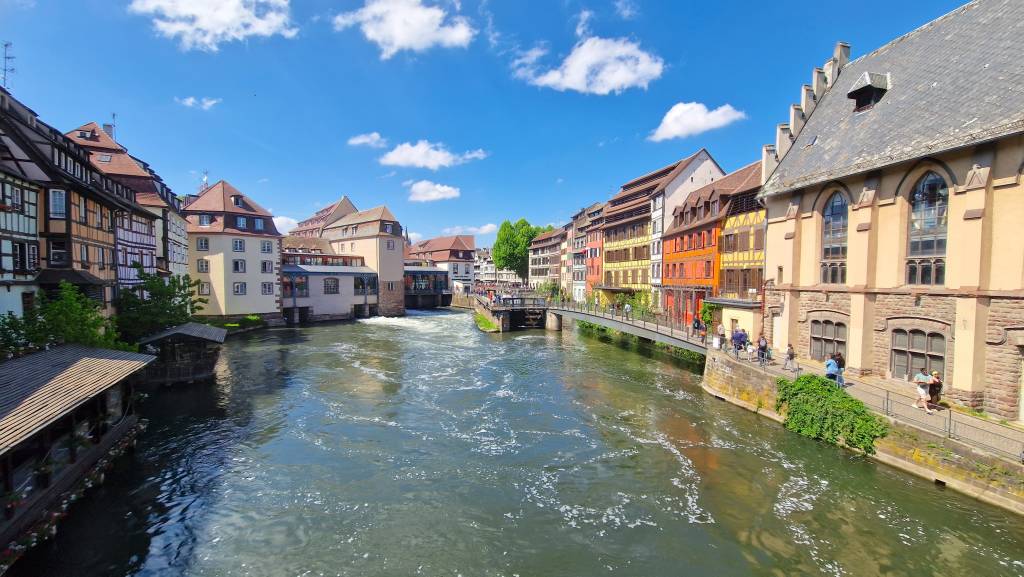
Photo 1. Strasbourg’s old town and the Ill River
Engagements at LIVE: Bridging ecology and planning
At the University of Strasbourg’s LIVE lab, I was warmly hosted by Dr. Audrey Muratet and Dr. François Chiron, and joined an interdisciplinary environment studying human–biodiversity interactions in urban settings. The lab connects research with local planning and development debates, acting as a caring voice for biodiversity. I also attended LIVE’s annual seminars on urbanisation effects on plants and streams, lifespan trajectories of large urban trees, among others. The presentations showed how ecology can inform urban planning and management.
In an internal seminar, I presented my doctoral research on pathways in green infrastructure planning, focusing on biodiversity-responsive and territorial perspectives. Discussing the work with an ecology-oriented audience was challenging but productive: their questions sharpened my understanding of how planning can engage with ecological knowledge. Through several brainstorming sessions, I also laid the groundwork for future collaboration with LIVE, exploring how built environments can become more resilient and inclusive for multispecies life.
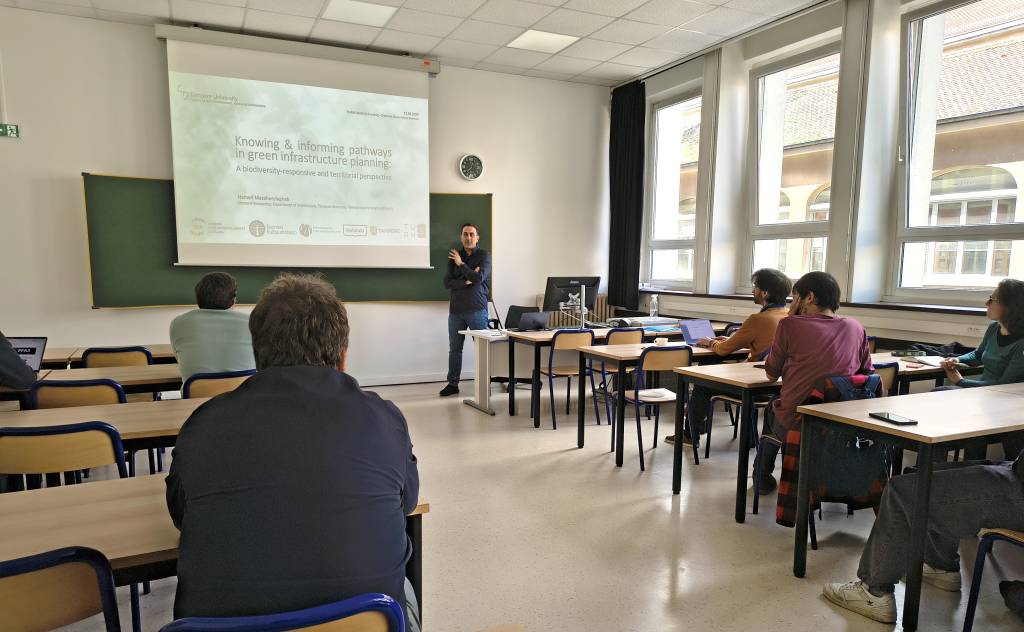
Photo 2. Delivering my doctoral research seminar at the LIVE laboratory
EvolVille: Strasbourg’s urban ecology observatory
At the heart of my visit was the EvolVille project (“evolving city” in French), a long-term urban biodiversity observatory launched in 2020 with municipal and metropolitan partners. EvolVille studies how species respond to urbanisation across 60 sites in and around Strasbourg, thereby informing local urban decision making. Each site captures a distinctive combination of two key gradients: landscape context (from urban core to rural areas); and herbaceous management intensity (from lawns to meadows and near-natural wastelands). To assess ecosystem conditions at each site, the team uses sensors to monitor soil, microclimate, light, and noise levels across sampling areas covering 15 m² for plants and 3.14 ha for birds. Over 6 years and 13,500 observations, they have recorded more than 900 species, from mosses and wildflowers to pollinating insects and birds. By comparing these sites annually, EvolVille is revealing patterns that offer practical guidance for urban planners and managers:
- Mowing frequency: Lawns mown very frequently (8+ cuts per year) host far fewer wildflowers and insects than meadows or wastelands mown only once or twice annually. These less intensively managed areas offer longer flowering seasons and more resources for pollinators (Photo 3, site 55). Some plants, such as orchard grass (Dactylis) and black medick (Medicago lupulina), almost vanish under constant mowing but flourish with minimal cuts (Sotillo et al., 2024). Changing mowing regimes can therefore enrich urban biodiversity.
- Light pollution: Bright night-time lighting deters light-sensitive bats but attracts some nocturnal flying insects, hence disrupting local trophic chains. EvolVille’s acoustic detectors found far less bat activity in well-lit parks, suggesting that artificial lighting drives sensitive species (and the insects they feed on) away. In response, city authorities are considering dimming lights in selected parks late at night to restore dark wildlife-friendly corridors (Photo 4, site 56).
- Urban heat islands: Concrete-heavy urban areas trap heat. At one inner-city site, a large lawn area surrounded by tall concrete buildings recorded Strasbourg’s warmest nights because heat stored in the surrounding walls radiated back into the space(Photo 5, site 90). This highlights the climatic need for more vegetation, natural shading, better ventilation, and more climate-sensitive materials to protect both people and wildlife from heat.
In short, while many urban species can adapt to city conditions through phenotypic plasticity and short-term changes in form or behaviour, others cannot survive extreme pressures. Maintaining diverse habitats, including wild refuges, is therefore crucial so that sensitive urbanophobic species are not pushed out of cities. EvolVille’s research model bridges academic research and urban practice by translating biodiversity data into practical everyday strategies.
Field visits: Rethinking with the wild in mind
The EvolVille work came to life when my hosts took me on a tour of several study sites —a day of grey skies but eye-opening insights into how biodiversity and environmental data are collected in urban spaces.
The hidden brownfield haven: Near the Rhine harbour, a disused railyard has become a meadow thriving on neglect. Dense wildflowers, hardy grasses, and low shrubs sprout through sparse soil along with some big old trees, providing food and shelter for migrating birds, bats, butterflies, uncommon snails, and more. Although the site is mown only once a year for possible development, this regime supports heterogeneity of smaller valuable species that would likely be lost if taller woodland dominated. It is a reminder that what planners may see as vacant land can actually be a biodiversity treasure.
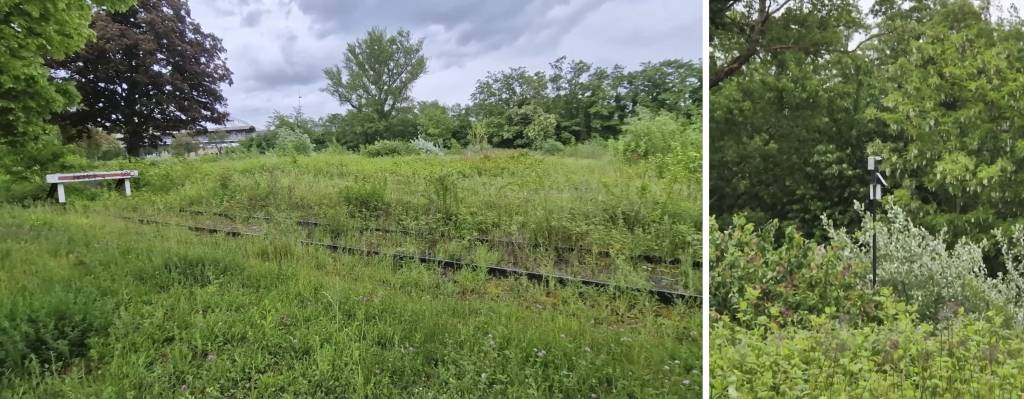
Photo 3. Left: A disused brownfield with dense and diverse species at the Rhône–Rhine harbour. Right: The installed station (site 55)
The riverside park corridor: Along a Rhine canal on the city’s outskirts and in the former riverbed of a Rhine branch, next to a large new housing development for 3,000 residents, an urban park is being carefully redesigned as a wildlife corridor while also serving human recreation. By keeping it dark at night without lampposts and supporting diverse native vegetation, the park functions as a habitat corridor for the movement and nesting of bats and birds despite its new human neighbours.Although not formally part of the development project, EvolVille researchers worked closely with the developer and local authorities to help preserve the park’s habitat corridor value.
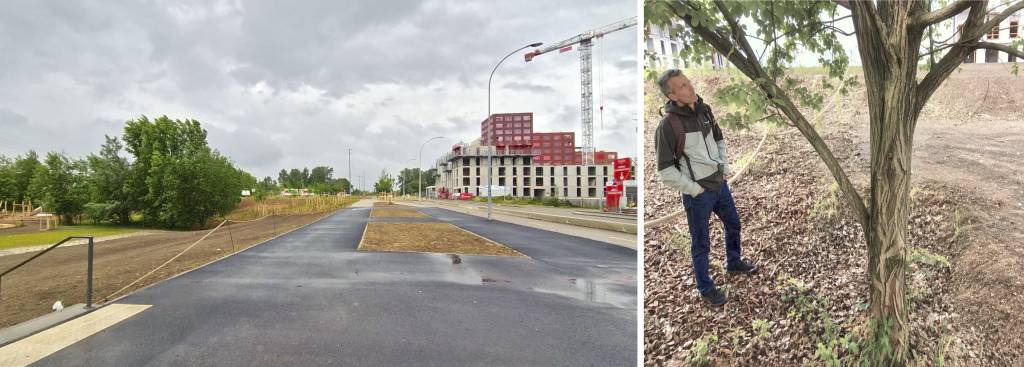
Photo 4. Left: A new urban park as a wildlife corridor, with unmown grasses and limited tall trees, alongside new and half-built tall buildings near the Rhône–Rhine Canal. Right: Observing bird nests in tall trees with F. Chiron (site 56)
A warm greenspace at night: Site 90 is a large lawn area and a schoolyard greenspace with limited trees, surrounded by concrete high-rise housing blocks. This site recorded the highest night-time temperature, reflecting strong heat island stress caused by warmth stored in the surrounding buildings during the day and released at night. The data showed a limited diversity of species, underscoring how strategic tree planting, improved ventilation, and more suitable building materials could help mitigate urban hot spots.
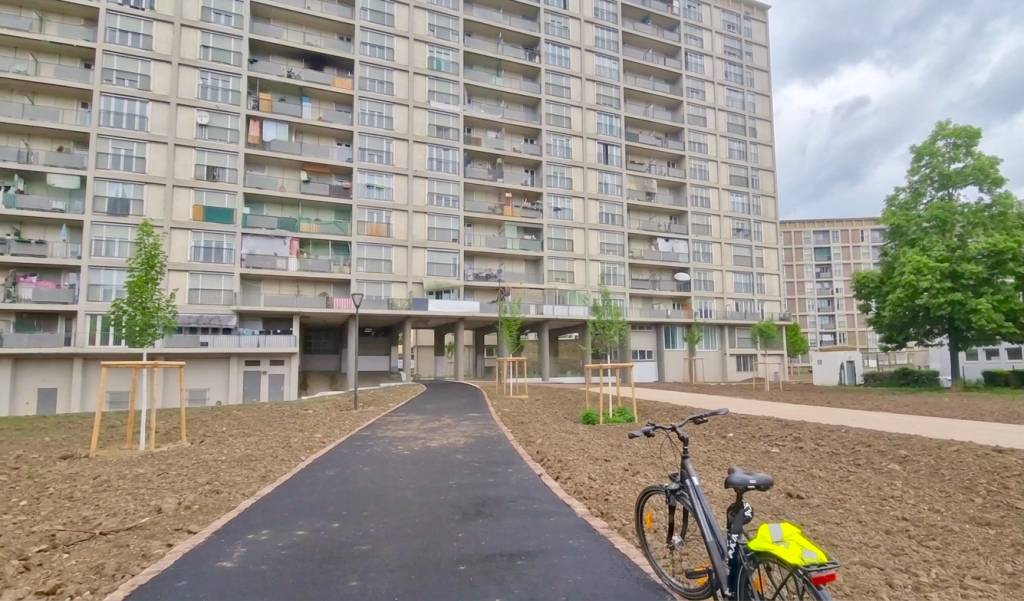
Photo 5. Large lawn area (now ploughed), heat-stressed by surrounding tall concrete buildings (site 90)
Takeaways: Planning cities for all life
My Strasbourg experience underscored the value of embedding ecology information into urban planning. By systematically observing biodiversity and engaging with local authorities, EvolVille researchers have informed planning choices and encouraged tangible changes —shaggier lawns, darker nights, and cooler blocks— that allow flora and fauna to flourish without sacrificing human needs. I now better understand that urban planners and managers should treat cities as shared habitats. By learning from ecologists and listening to what birds, bees, and bats might tell us through data, we can plan cities for multispecies life, with both wings and roots in mind.
Hamed Mazaherylaghab is an Iranian doctoral researcher at Tampere University focusing on biodiversity-responsive green infrastructure planning. A SAFA and IRCEO architect by training, he often explores how built form can meaningfully integrate greenery and multispecies cohabitation.
Acknowledgements: The author thanks François Chiron and Audrey Muratet at LIVE for their generous hosting and collaboration. This research visit was supported by Tampere Urban Research Network for Sustainability (TURNS) Mobility Funding 2026.
Further reading:
Sotillo, A., Hardion, L., Chanez, E., Fujiki, K., & Muratet, A. (2024). Plant responses to urban gradients: Extinction, plasticity, adaptation. Journal of Ecology, 112(12), 2861-2875.
Hardion, L., Muratet, A., Sotillo, A., Chanez, E., Hector, A., Chiron, F., Couturier, N., Derminon, S., Fujiki, K., Gurisik, C., Herrault, P.A. (2024). Cahier ÉVOLVILLE, L’évolution s’invite en ville – Réponses des plantes aux gradients environnementaux urbains.Plan Urbanisme Construction Architecture (PUCA), Paris.
The EvolVille project website: https://live-evolville.unistra.fr/