



Land value differentiation lies at the heart of processes that shape urban space both within and across cities. In large urban areas, coalitions of local governments, developers, firms, and public organizations frequently form around growth-inducing urban development projects (Logan & Molotch, 2007). These projects often involve intensified land use and the construction of housing and amenities designed to attract “high-value” residents, visitors, and capital. As a result, land values rise, along with the value of housing assets built upon it. Speculation around increasing asset values further attracts transnational financial capital. While these dynamics generate profits for asset-owning investors and residents, they simultaneously challenge the inclusivity of urban spaces and reduce housing affordability (Adkins et al., 2020; Aalbers, 2015).
Conversely, in urban areas where land values are comparatively low, stagnant, or declining—such as the margins of metropolitan regions or in ‘shrinking’ cities—growth coalitions tend to be absent. Here, land and housing assets are often subject to speculation around potential value decline. Nevertheless, pressures for urban renewal and growth persist, as local governments seek to adapt to shifting economic realities. These dynamics also have implications for the inclusivity of urban spaces and the quality of housing conditions.
Our session engaged with diversity of context dependent combinations between land value differentiation, the assetization of housing, and the valuation of residents, whether desired residents or actual residents, whose living conditions are at stake.
Discussions about “housing crisis” tend to focus on rapidly growing urban centres where rents continue to rise, social housing production decreases, and home ownership becomes increasingly unattainable. However, Eija Meriläinen’s and Susanna Heldt Cassel’s research redirects attention toward “left behind” places. In deindustrializing regions and areas experiencing population decline, residents face different but equally pressing challenges, including deteriorating housing quality, limited rental options despite vacancies, and difficulties finding or accessing suitable homes. Their work on municipalities of Kemi and Keminmaa in Northern Finland demonstrates that housing crises take multiple forms and that (national) policies focused exclusively on metropolitan growth risk overlooking large segments of the population.
At the same time, shrinking regions are developing new responses to these challenges. Annamari Kiviaho’s research on three Finnish municipalities revealed how they aim to act as active market shapers. Local governments are demolishing vacant, municipal owned rental housing to reduce oversupply, facilitating property transactions, and seeking new ways to attract residents and businesses. These strategies illustrate how declining regions are attempting to manage the consequences of weak demand and uncertain property values while preserving community vitality. Yet they also underscore a broader reality: housing markets are increasingly dependent on public intervention, whether in regions experiencing rapid growth or long-term decline.
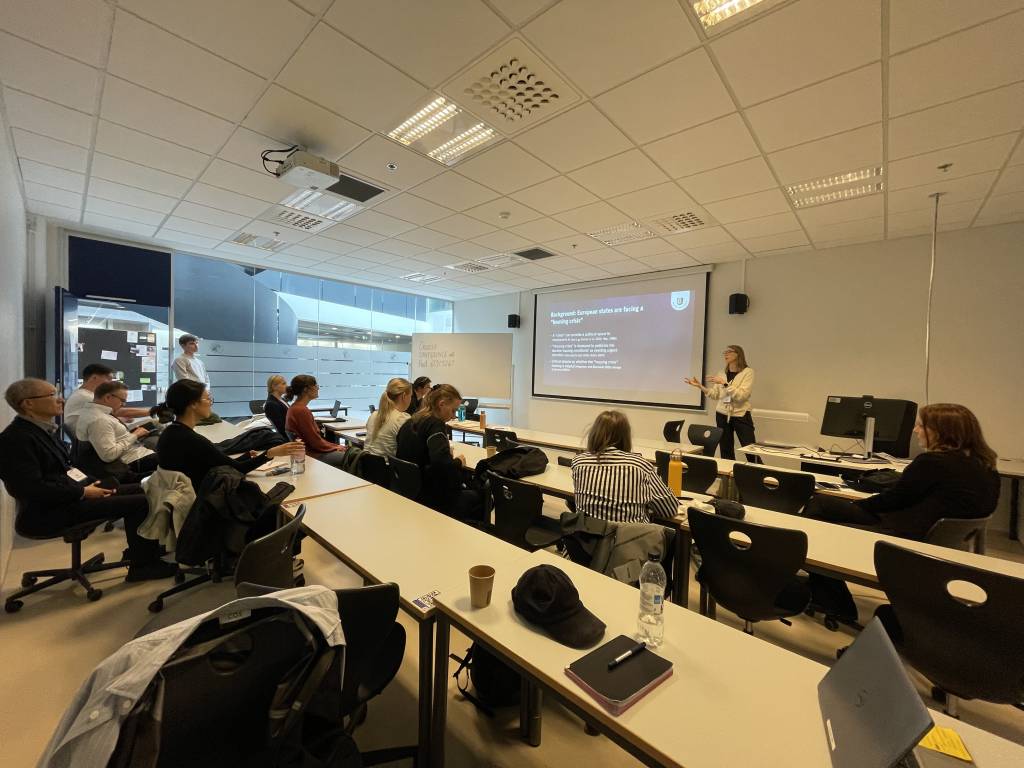
Matthew Howells’ research on Danish housing associations illustrates how urban redevelopment also relies on institutions that mediate between public goals and market interests. Housing associations, traditionally associated with affordable and socially oriented housing provision in Denmark, are increasingly drawn into growth-oriented redevelopment partnerships. While these arrangements can generate investment and promote urban renewal, they also create tensions between social objectives and commercial pressures. Howell’s findings suggest that redevelopment outcomes are profoundly shaped by local housing market conditions and land value dynamics, producing uneven results across different places.
Urban growth agendas are also mediated through seductive visual representations. Salla Jokela, drawing on her research with Markus Laine and Aurora Luukkanen about the Daniel Liebeskind-designed Tampere Deck Arena megaproject, illustrated aptly the growing role of imagery and storytelling in urban development. Their research suggests that architectural images do more than illustrate future developments; they actively shape public imagination, attract support, and legitimize large-scale investments. This insight expands traditional growth machine theory by showing how symbolic and visual capital can operate alongside financial capital in driving urban transformation.
Assetization is pervasive throughout urban life as Mikko Kyrönviita’s presentation on urban waterfront transformations with a particular focus on leisure illustrated. Once industrial or inaccessible, waterfronts are increasingly redeveloped into attractive leisure landscapes featuring promenades, swimming facilities, saunas, and recreational infrastructure. These amenities enhance quality of life and strengthen connections between people and water. However, they also contribute to rising land values and new forms of exclusion. Waterfront leisure spaces have become economic assets that support real estate development, shape desirable lifestyles, and attract investment as well as “good” tax paying residents. As a result, questions emerge about accessibility, affordability, and who benefits from these celebrated urban transformations.
Despite their diverse empirical focus, the session presentations shared a common concern with the increasing assetization of land, housing, leisure, and urban experiences in contemporary financialized urban and regional development. The enduring challenge for local governments and policymakers has been, and will continue to be, balancing economic growth with social inclusion, housing affordability, and the broader public interest.

Mikko Kyrönviita, Salla Jokela (Tampere University), & Eija Meriläinen (Örebro University/University of Vaasa)
Mikko Kyrönviita and Salla Jokela work in Contested Waterfront Transformations project which investigates the outcomes of prevailing policy ideals of social inclusion in waterfront developments as they face variations of increasingly financialized urban growth machines. Eija Meriläinen is an Associate Professor of Regional Studies at the University of Vaasa.
Further reading:
Aalbers, M. B. (2015). The Great Moderation, the Great Excess and the global housing crisis. European Journal of Housing Policy, 15(1), 43–60. https://doi.org/10.1080/14616718.2014.997431
Adkins, L., Cooper, M., & Konings, M. (2020). The Asset Economy (1st edition). Polity.
Logan, J. R., & Molotch, H. (2007). Urban fortunes: The political economy of place, with a new preface (20th anniversary edition). University of California Press.


