
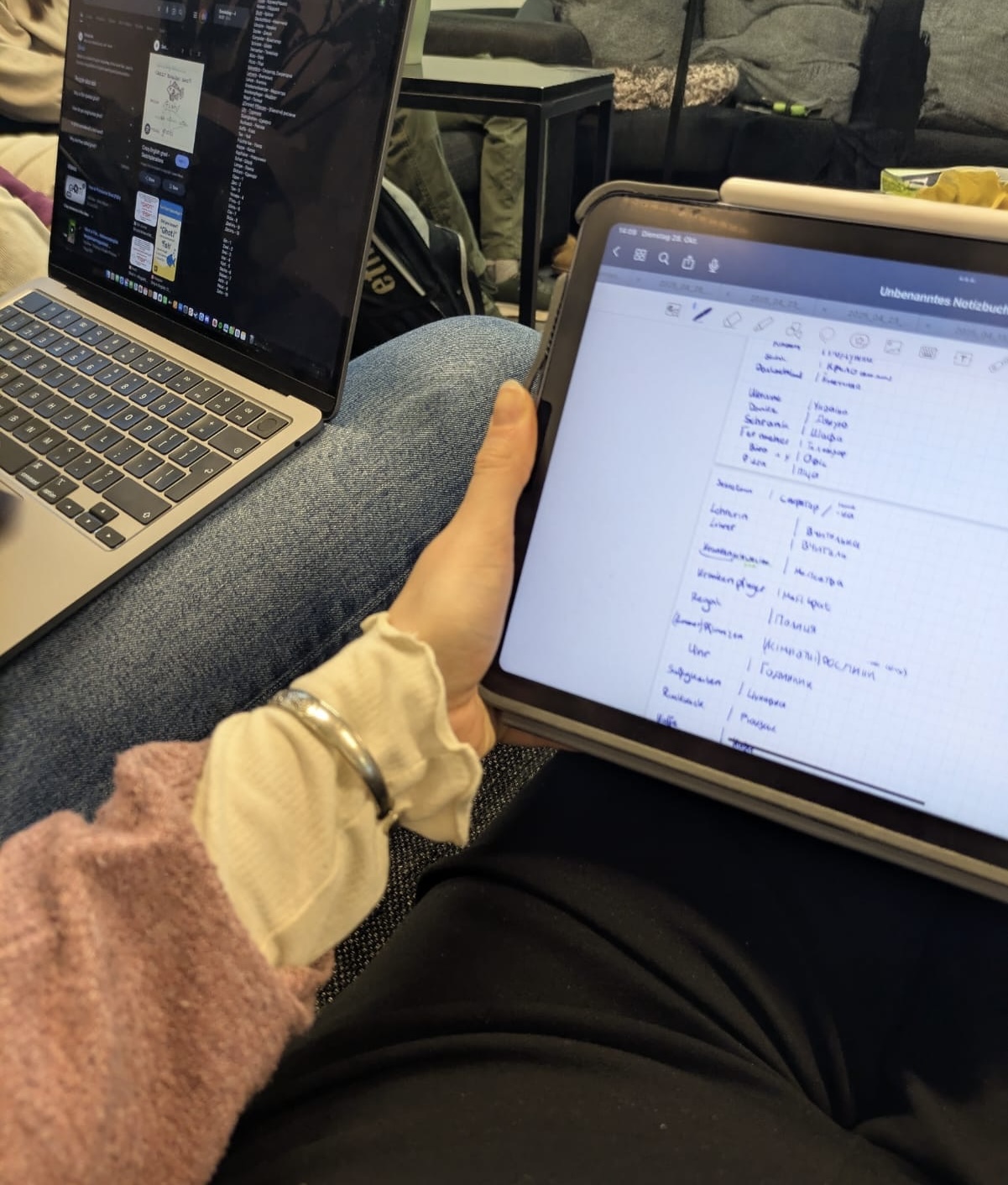
This time we had a very theoretical lesson and talked a lot about language development, similarities and differences.
“Smalellilg” is different in our languages, as in common German you can add -i in the end to specify an object as puny or cute, but in ukrainian there are many unique variations, depending on the word (e.g. маленький, ведмежатко, цуценя, etcetera).
In Ukrainian it’s a modern trend to bring up and create feminine versions of the words standing for jobs, in example Директор – male director, but Директорка – female director. Meanwhile in German it’s quite a common practice, with some exceptions. In regular words you add -in in the end (Lehrer – male teacher, Lehrerin – female teacher), but sometimes you’ll need to change a part of the word to specify the gender of a person (Krankenschwerster – female nurse, but Krankenpfleger – male nurse).
Some words have also went to Ukrainian from the west, but used less, or differently. For instance, Office in German and Ukrainian respectively will be Büro and Офіс. But Büro is also a word in Ukrainian, but used less to specify a working area of regular working people. Usually the word is used to specify some governmental or police departments.
Some sounds can also be met in both languages, for instance short z in German is ц in Ukrainian, and sometimes German ß can remind of Ukrainian з(z), at least visually. What is funny, if people want to swear, but not to use the curse words, Germans and Ukrainians do it quite similarly – Mein Gott and Боже Мій (respectively), meaning my god in English.
Yevhen Hrechko, Marie Gebert


Comments