There are games that arrive with expectations attached to them.
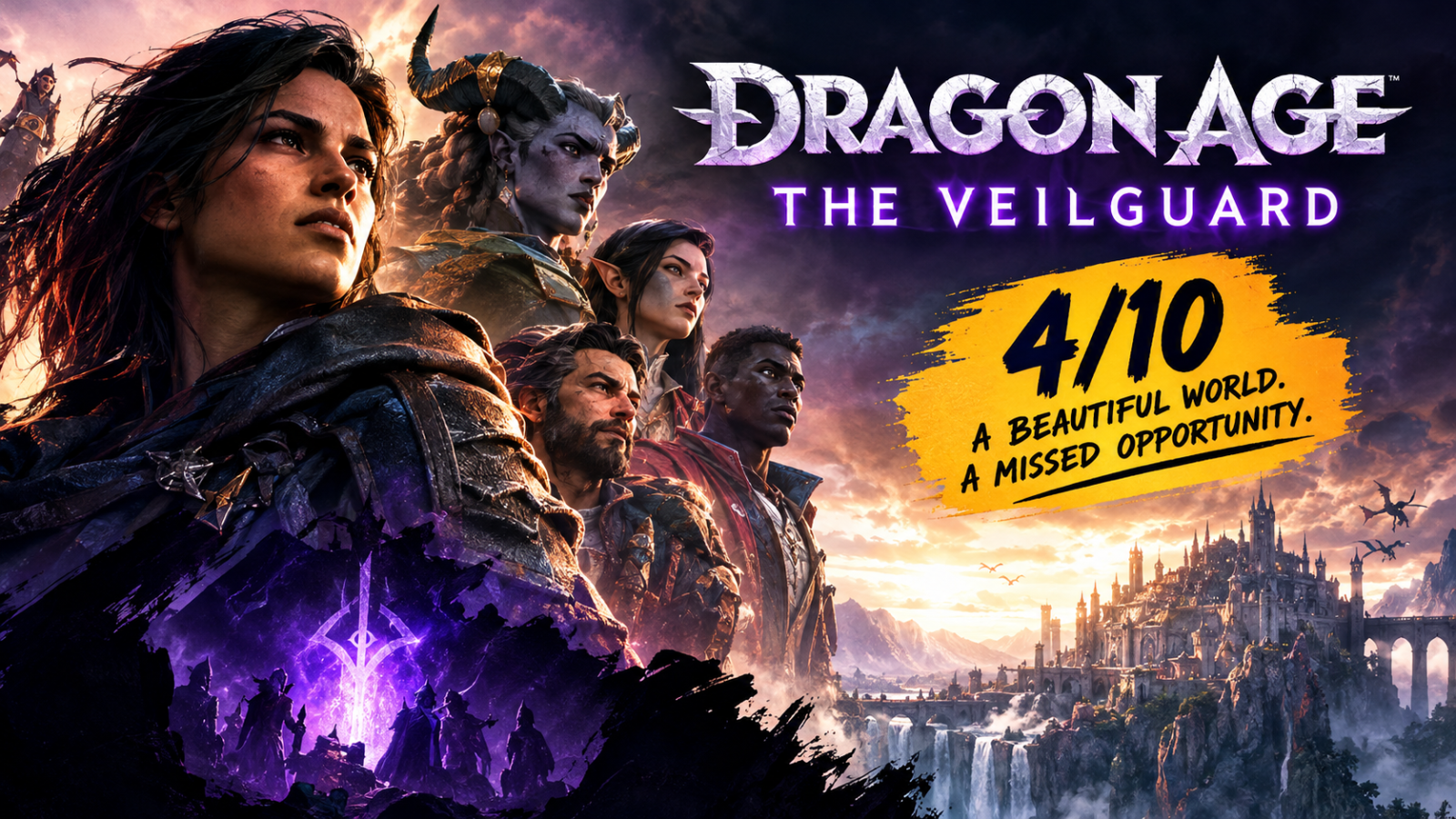
Then there is Dragon Age: The Veilguard.
This poor thing didn’t simply have to be a good video game. It had to be Dragon Age. It had to follow Dragon Age: Origins, Dragon Age II, and Dragon Age: Inquisition. It had to justify a decade-long wait. It had to convince people that BioWare still had some of that mysterious “BioWare magic.” It had to survive comparisons with The Witcher 3, Baldur’s Gate 3, Mass Effect, and basically every RPG released since 2014.
Oh, and it had to deal with the internet. So, naturally, everyone arrived carrying flamethrowers. After playing The Veilguard, the strange thing is that neither side of the argument quite gets it right. It isn’t the catastrophic abomination some corners of the internet wanted it to be. It also isn’t the triumphant return of classic BioWare that others desperately wanted it to be. It is something much more frustrating: a perfectly enjoyable, frequently gorgeous, occasionally excellent RPG that repeatedly makes baffling decisions.
It is the gaming equivalent of ordering an expensive steak and receiving a very nice hamburger.
The hamburger is good.
You just keep looking at the menu wondering where the bloody steak went.
So, What Exactly Is The Veilguard?
Dragon Age: The Veilguard is BioWare’s fourth major entry in the Dragon Age series, arriving ten years after Inquisition. It puts you in the boots of Rook, a new protagonist who becomes the leader of a group assembled to prevent an enormous magical catastrophe. The catastrophe involves Solas, the elven trickster/god/egg-headed philosophical nightmare who fans will remember from Inquisition. Solas is attempting to tear down the Veil separating the physical world from the Fade. Things go spectacularly wrong. Two ancient elven gods escape. The world starts going to hell. Literally, in some places.
So Rook assembles the Veilguard and goes off to save Thedas. Simple enough. Except this is Dragon Age, meaning that before long you’re dealing with ancient gods, elves, demons, dragons, necromancers, assassins, magical cities, secret societies, blight, political factions, dead people, very angry people, and at least one person who probably needs several years of therapy.
And credit where credit is due: Thedas has never looked this good. The environments are spectacular. The character models are detailed. The lighting is excellent. The cities, forests, coastlines and magical environments can look absolutely gorgeous. The game is almost offensively pretty. There were moments when I wanted to stop playing and simply take screenshots. And then the game would give me another corridor with three enemies standing politely in a row waiting for their scheduled appointment with my sword. Which brings us neatly to the first major problem.
The Combat: Surprisingly Good Until You Realize You’re Doing the Same Thing Again
Let’s get something out of the way.
The combat is fun.
I know, I know. This is supposed to be the part where I angrily throw a chair through a window. But no. The combat system is actually one of The Veilguard’s strongest elements. BioWare has moved away from the slower, more tactical combat associated with earlier Dragon Age games and embraced a much more action-oriented system. Rook can dodge, parry, block, charge attacks, unleash abilities, fire projectiles and generally run around the battlefield like an extremely annoyed member of the local theatre department. The system feels responsive. When you nail a parry, it feels satisfying. When you chain abilities together properly, enemies explode in impressive fashion. And boss encounters can genuinely be excellent. The problem is that the combat system is considerably better than the enemies you’re frequently using it against.
A lot of encounters boil down to:
Enemy appears. You hit enemy. Enemy develops an alarming amount of health. You continue hitting enemy. Enemy continues existing. You question your life choices. Enemy finally dies. Repeat.
The enemy variety doesn’t always provide enough mechanical variety to keep the system interesting over a lengthy campaign. Video Games Chronicle made a similar criticism, noting that fights can become repetitive and that some enemies compensate for limited challenge by simply having large health pools. (VGC)
And that is the problem. A giant monster with an enormous health bar isn’t necessarily an interesting enemy. It’s just a very angry spreadsheet. The combat occasionally feels like BioWare has created a fantastic set of tools and then forgotten to give you enough interesting things to use those tools against.
The Mage Problem
There is another wrinkle. Your experience with combat can depend heavily on which class you choose. The warrior is straightforward. The rogue is fast, responsive and satisfying. The mage, meanwhile, can occasionally feel like the game has decided that magic is a lifestyle choice rather than a combat system.
GameSpot specifically criticized the mage experience, particularly its targeting and lock-on behavior. The review found that ranged combat could become awkward, with enemies moving outside the lock-on system and forcing players to spend too much time searching for targets. (GameSpot)
And this is particularly unfortunate because playing a mage in Dragon Age should feel special. In earlier games, magic wasn’t simply “sword, but purple.” The mage was a different way of interacting with the battlefield. Here, depending on your build, combat can feel much more homogenized. Still, once the system clicks, there is plenty of fun to be had. The problem isn’t that The Veilguard has bad combat. The problem is that you can see how much better it could have been.
The Companions: BioWare Still Knows How to Make People
And now we reach the section where I have to reluctantly put down the pitchfork. Because the companions are good. Some are really good. BioWare has always understood that players don’t necessarily remember every corridor they walked through or every bandit they murdered. They remember characters. They remember conversations. They remember friendships. They remember the weird bloke who stood in the corner of the tavern saying something completely inappropriate.
The Veilguard understands this. Your companions are the emotional center of the game. You have a varied group with different personalities, histories, conflicts and motivations. Emmrich, for example, is a necromancer who has an almost absurdly gentlemanly relationship with death and somehow it works. Lucanis is an assassin with enough emotional baggage to fill several luggage carousels. Neve is a detective with an appropriately cynical worldview. Davrin is a Grey Warden who spends an alarming amount of time trying to stop everyone else from getting themselves killed. Harding is there because apparently the universe decided that one more lovable dwarf was required.
And then there is Taash.
Oh, Taash. Look, there is nothing inherently wrong with a character exploring identity, family expectations, culture, or gender. Those are perfectly legitimate subjects for a game to tackle. The problem is how The Veilguard handles them.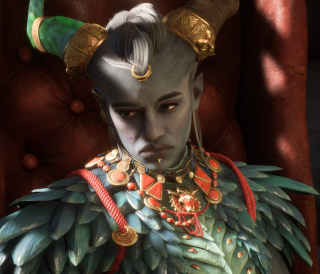
Taash’s storyline can feel less like a naturally developing character arc and more like BioWare has scheduled a compulsory seminar and then forgotten to provide an exit button. The biggest issue isn’t that Taash has things to say. It’s that the game is sometimes remarkably unsubtle about what it wants you to take away from those conversations. Instead of allowing the character’s identity and personal struggles to emerge organically through the world, relationships, and choices, the writing can feel as though it is standing beside you with a PowerPoint presentation.
Slide one: Taash’s identity.
Slide two: Taash’s identity, but with slightly different wording.
Slide three: Please make sure you understood the identity from slides one and two.
And before anyone starts sharpening the pitchforks: no, this isn’t an objection to the subject matter itself. Dragon Age has always dealt with uncomfortable questions about identity, prejudice, culture, religion, sexuality, class and social expectations. That’s nothing new for the series. The problem is dramatic subtlety. Earlier Dragon Age characters could communicate enormous amounts about themselves without constantly explaining themselves to the player. Their personalities emerged through arguments, friendships, romances, disagreements and the choices they made. You could disagree with them. You could misunderstand them. You could even dislike them. Taash is more difficult because the writing sometimes seems determined to make sure the player never has the opportunity to misunderstand what the character is experiencing. And that makes the character feel less like a person and more like a vehicle for a message.
It also doesn’t help that Taash can be abrasive without always being particularly entertaining. Characters such as Morrigan, Vivienne, Fenris, Aveline and even Sera could be difficult, irritating or confrontational, but their personalities created friction that made the party feel alive. You didn’t necessarily agree with them, but you wanted to hear what they had to say. With Taash, there are moments when I wasn’t thinking, “What an interesting character.”
I was thinking: “Oh God, are we doing another one of these conversations?”
And that’s not where you want the player’s attention to go. A good character arc should make you curious about the person. This one constantly makes you conscious of the writer.
Taash’s personal storyline has some worthwhile emotional material, particularly concerning family expectations and the tension between different cultural identities. But the execution lacks the subtlety that made earlier BioWare writing so memorable. The game frequently tells us what Taash is feeling rather than letting us discover it through behavior, conflict and consequence. It is the difference between a character saying, “This is who I am,” and a character behaving in ways that make you understand why they have become who they are. The former is exposition while the latter is storytelling.
The frustrating thing is that Taash could have been an excellent character. There is genuinely interesting material here: family, cultural expectations, belonging, personal identity, anger, insecurity and the question of how much of yourself you should change to satisfy other people. But instead of trusting the player to engage with it, the game occasionally treats us like we’re twelve minutes late to a mandatory orientation session.
The Banter Problem
Dragon Age companions have historically been brilliant because they weren’t always nice. They disagreed. They insulted each other. They questioned your decisions. They had political arguments. They could be complete bastards. Sometimes you wanted to hug them. Sometimes you wanted to throw them off a cliff. Occasionally you wanted to do both. That tension was part of the fun. The Veilguard is considerably softer.
Characters generally behave like people attending a very expensive conflict-resolution seminar. Everyone communicates and explains their feelings, the latter rather extensively.
Someone has just unleashed an ancient god upon the world and the response is basically: “Let’s talk about what happened.”
And I’m sitting there thinking: Mate, we don’t have time for a feelings worksheet. The apocalypse is currently happening outside.
This isn’t necessarily bad writing. It’s simply a very different tone from the earlier games. The Guardian also noted that some companion banter can feel strangely formal, almost like colleagues making small talk at an office party. (The Guardian)
And that’s exactly the problem. The game sometimes feels less like a group of dysfunctional adventurers and more like the world’s most emotionally literate workplace.
Rook: The Hero Who Accidentally Wandered into Their Own Game
Rook is probably my biggest narrative problem. Not because Rook is terrible.
Rook is simply… there.
Your character is supposed to be the center of this enormous story, yet the game doesn’t always provide a convincing reason why Rook is the person who must lead everyone. GameSpot made essentially this criticism, arguing that the narrative doesn’t establish a particularly compelling reason for Rook’s unique importance. (GameSpot)
And that’s a problem. Think about previous Dragon Age protagonists.
The Warden? A Grey Warden dealing with a Blight.
Hawke? A person whose life becomes increasingly entangled with the political and magical chaos of Kirkwall.
The Inquisitor? A person with a magical mark who becomes central to a world-shattering conflict.
Rook? “Well… somebody has to do it.” And apparently that somebody is you.
Congratulations. You have been promoted to Apocalypse Manager.
Rook is technically a vessel through which the companions experience their stories rather than a compelling character in their own right. The dialogue choices are also rather strange. You can select different responses, but the game frequently pushes Rook toward being friendly, supportive and witty. Even when you’re trying to role-play a more serious character, Rook has an uncanny ability to sound like the person who writes jokes for a fantasy sitcom. You’re not necessarily choosing who Rook is. You’re choosing which flavor of generally nice person Rook will be today.
The Writing: This Is Where Things Get Messy
Here we come to the controversial bit. And by “controversial,” I mean the part where everyone on the internet starts sharpening knives. Let’s separate two things. The game contains good writing. It also contains bad writing. Both statements can be true.
The central problem is that The Veilguard often lacks the sharpness of its predecessors. The older Dragon Age games weren’t afraid to let the world be ugly. People lied. Governments did horrible things. Religious institutions were compromised. Characters betrayed each other. Your choices could make somebody hate you. There were moral situations where there wasn’t an obvious answer.
The Veilguard is much more interested in making sure everyone gets along. And this can make the world feel strangely safe. The game is dealing with ancient gods and apocalyptic destruction, yet the emotional temperature often remains surprisingly comfortable. Even conflict between companions frequently feels as if someone has scheduled a supervised mediation session.
The Game Really Doesn’t Trust You
This is probably my favorite criticism of The Veilguard because once you notice it, you can’t stop noticing it.
The game explains everything.
Then explains it again.
Then someone mentions the thing you just saw.
Then another character mentions the thing.
Then you receive a quest summary explaining the thing.
Then the game reminds you what you’re supposed to be doing.
Then somebody says: “Remember that thing we’re doing?”
YES. I REMEMBER. I WAS THERE.
This is particularly strange for a game aimed at RPG players. RPGs are supposed to make you feel like you’re living inside a world. You should be able to miss something, discover something. You should occasionally think: “Wait… what’s going on?” That’s part of the fun. Instead, The Veilguard sometimes behaves like an overly enthusiastic tour guide.
The RPG Problem
Here’s another curious thing. The Veilguard calls itself an RPG. But it is a much more streamlined RPG than Origins. There is less inventory management, less micromanagement, and fewer tactical considerations. Companions don’t have traditional health bars that require you to manage them in the same way. Gear is heavily streamlined. Respeccing is easy.
BioWare has removed many of the annoying parts of RPGs. Unfortunately, some of those annoying parts were also the things that made the game feel like an RPG. There’s a fine line between convenience and simplification. The Veilguard occasionally trips over that line, falls down the stairs and lands in a pile of simplified skill trees.
Character Creation: Absolutely Marvelous
Now let’s talk about something the game absolutely nails: Character creation. This thing is ridiculous. You can customize Rook extensively: face, hair, body, features, scars, and tattoos.
You can spend an embarrassing amount of time creating your protagonist before realizing that you have not actually started the game. “Right, I’ll just adjust the jaw.” Two hours later: “Maybe the cheekbones could be slightly more…” You know how it goes. And it deserves the praise.
It is one of the most flexible systems in a modern BioWare game. The ability to create a character who actually looks distinctive is fantastic. Unfortunately, once you’ve created the most magnificent fantasy warrior known to Thedas, Rook spends the next seventy hours saying: “Well, gosh, this is quite a situation.”
Romance: Please Stop Announcing My Feelings
Romance has always been a major part of BioWare games. And The Veilguard has romance options. But romance is considerably more explicit in its signaling. Sometimes the game practically taps you on the shoulder and says: “THIS IS A ROMANTIC MOMENT.”
Yes. Thank you. I had noticed.
It occasionally treats romance like an achievement notification. Congratulations! You have experienced a feeling! Would you like to press A to continue?
The romances themselves can be enjoyable, particularly because they emerge from companion relationships, but the presentation occasionally removes the subtlety and romance works best when the player feels like they’re discovering the relationship rather than following a series of enormous flashing arrows.
The Visuals: No Complaints Here
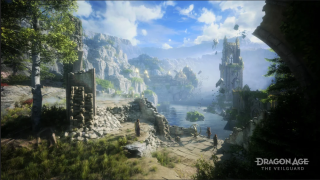
If the writing sometimes stumbles, the artists were apparently given unlimited coffee. The Veilguard is gorgeous. The environments are colorful, distinctive and often dramatic. The art direction is perhaps one of the game’s most successful aspects. The world doesn’t simply look technically impressive. It looks designed. Cities have character. Magical environments look magical. The characters have expressive faces. The cinematics can be spectacular. And the game runs surprisingly well on PC.
And that matters. After years of technically troubled AAA launches, The Veilguard arriving in a comparatively polished state deserves credit. BioWare released several patches after launch addressing bugs, crashes, visual issues and quality-of-life problems, including Patch 5 in January 2025. So while I’m happy to mock the game’s storytelling decisions, I’m not going to pretend it’s some broken technical disaster. It isn’t.
Exploration: Beautiful, But Please Stop Putting Things in My Way
Thedas looks fantastic. Exploring it can also be surprisingly enjoyable. But exploration itself is often less interesting than the scenery. There are plenty of locked doors, blocked paths, magical obstacles, crystals, cubes, blight growths, switches, more crystals, and another bloody cube.
You will develop a relationship with cubes that you did not ask for.
And that criticism is justified. The game repeatedly uses the same kinds of environmental interactions. Eventually you stop thinking: “How do I solve this?” and start thinking: “Oh, there’s the thing I’m supposed to hit.” It’s not terrible. It’s just uninspired. And that’s perhaps the most frustrating word you can use about a Dragon Age game. Not terrible. Uninspired.
The Biggest Problem: It Doesn’t Quite Feel Like Dragon Age
This is ultimately where I land.
Not: “This game is garbage.”
Not: “This game is the glorious return of BioWare.”
Something much more uncomfortable.
It is a good game that sometimes feels like a strangely sanitized version of Dragon Age. And that’s a very different criticism. The Guardian called it “a good RPG, but an underwhelming Dragon Age game,” which is probably one of the more useful ways to understand the whole experience. (The Guardian)
The game has the furniture, companions, romances, choices, fantasy, politics, magic, elves, dwarves, Grey Wardens, dragons, ancient gods, mysterious magical nonsense. It’s all there.
But sometimes it feels like somebody recreated Dragon Age from memory.
“Okay, what does Dragon Age have?” “Elves.” “Excellent.”
“Magic.” “Good.”
“Political conflict.” “Yes.”
“Morally questionable decisions?” “…Maybe not too much.”
“Why?” “We don’t want anyone to feel uncomfortable.” “Fine.”
“How about the player being allowed to be a complete bastard?” “Absolutely not.”
And that’s the problem. Earlier Dragon Age games allowed players to make ugly choices. The Veilguard is much more comfortable telling a story where everyone is fundamentally decent. That’s not inherently bad, but it removes some of the edge.
So, Should You Buy It?
Here’s what I would tell you, dearest consumer.
Yes, potentially — but know what you’re buying.
If you want a traditional Dragon Age experience that resembles Origins, you’re probably going to have a difficult relationship with this game.
But if you want something closer to an action RPG with BioWare companions, cinematic presentation and a heavily streamlined RPG system, you’re going to have a much better time.
If you love character creation, companion quests and action combat, there is a lot here. If your favorite thing about Dragon Age is its morally complicated politics, tactical combat and ability to roleplay a maniac, you’re going to notice what’s missing.
And if you’re wondering whether the game is worth buying at full price, my answer is slightly different from whether it’s worth buying on sale.
At full price?
You’re paying premium money for a game that sometimes feels like it has been sanded down until all the sharp edges have disappeared and those sharp edges were part of the reason Dragon Age was interesting.
At a discount?
Maybe…
The game has enough good material to justify spending time with it, particularly if you approach it as an action RPG rather than expecting Origins 2.
Final Verdict
Dragon Age: The Veilguard is a strange game.
It is polished. It’s beautiful. It’s occasionally fun. It contains some genuinely excellent companion stories. It has one of the best character creators BioWare has ever made and it has satisfying combat.
But it also has repetitive encounters, simplified RPG systems, overly safe writing, excessive hand-holding, inconsistent dialogue and a protagonist who sometimes seems to have happened to be in the story because everyone else was busy.
And the big bloody elephant in the room is that it is nothing like a Dragon Age game.
To top it off with another food-related allegory: Dragon Age: The Veilguard is the game equivalent of ordering a full English breakfast and receiving avocado toast prepared by somebody who has heard about bacon but has never actually met a pig.
It’s pleasant and attractive and it will probably leave you satisfied. But somewhere deep in your soul, you’re still asking: “Where the hell are the sausages?”
My consumer verdict: 4/10
It is worth playing. It is worth experiencing for yourself. It has some excellent moments.
But if you go into it expecting Dragon Age: Origins, you may spend much of the adventure staring at your screen wondering who replaced BioWare’s medieval political drama with a very expensive group therapy session.
And if you go into it expecting an accessible, colorful action RPG with fun companions, flashy combat and a ridiculous amount of character customization?
Well…
You might actually have a rather good time. Just don’t expect the game to let you forget what you’re doing. Because approximately seventeen seconds after you accept your quest, someone will remind you. And then someone else will remind you. And then your quest journal will remind you. And then Rook will probably explain it to you just in case you forgot.
We know, Rook.
We know.
Dragon Age: The Veilguard
Publisher: Electronic Arts
Developer: BioWare
Platforms: Windows, Xbox Series X, PlayStation 5
Release Date: 31 October 2024
Genres: Action-RPG, RPG, Fanstasy
PEGI: 18