Have you played Buckshot Roulette, or heard of Mike Klubnika? You may already be familiar with the industrial dystopian atmosphere that defines his work. In 2026, Klubnika and fellow developer GDeavid released a new party game that has been described as Mario Party meets Saw. If you’re a fan of industrial horror and fancy a life-or-death showdown with your friends in the style of Squid Game, then you definitely should not miss Machine Party.
Machine Party supports online play for two to four players, throwing them into a deadly environment filled with traps, chainsaws, landmines and firearms across fifteen unique mini-games. From a mechanical perspective, they can be divided into reaction-based, memory-based and direct player-versus-player contests. Players progress through each challenge and earn points based on their performance. In the end, the player with the highest total is the one who escapes.
Players frequently point out that the game lacks an official public server browser and built-in voice chat, which means you will usually need to bring your own group. Then again, getting beaten up by someone you know is far more thrilling than being attacked by a stranger. If you can get a group together, it’s worth experiencing for its tense atmosphere and constant backstabbing.
“Help! I’m trapped in the eternal factory”
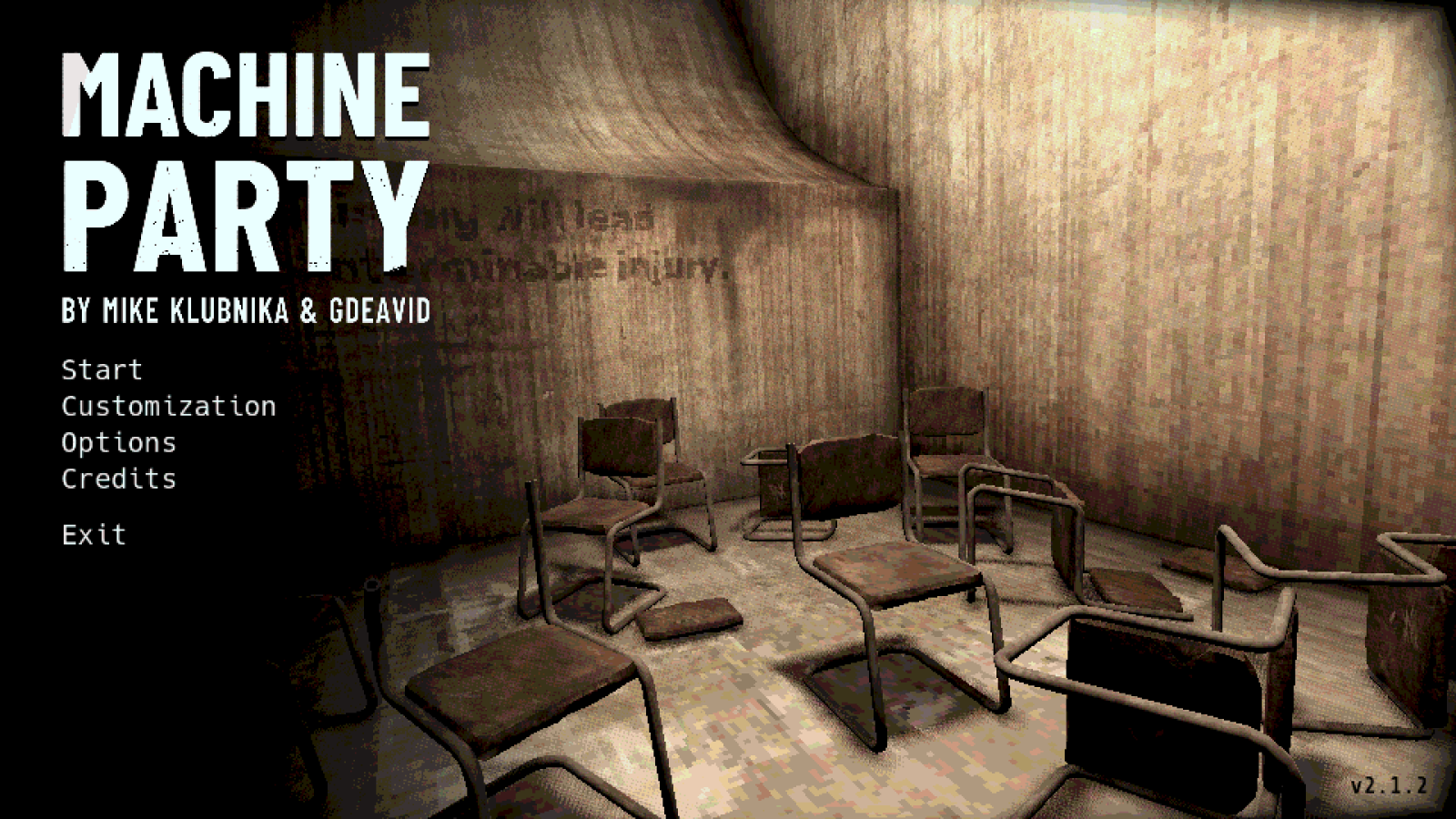
Unlike cooperative party games such as Overcooked!, Machine Party establishes a dangerous, battle-royale-style atmosphere from the beginning. As soon as the game launches, Alex Peipman’s industrial electronic soundtrack transports players into a derelict factory. Heavy mechanical beats imitate the sounds of rusty pistons pumping and hammers striking metal. The humming during loading screens, hollow and fleeting echoes, and glitchy electrical noises all heighten the sense of unease. Dark, gloomy tones dominate the environment: crumbling grey walls, creaking forklift trucks, and gears and conveyor belts covered in thick dust. The only real splash of color is the blood spattered everywhere when a player dies.
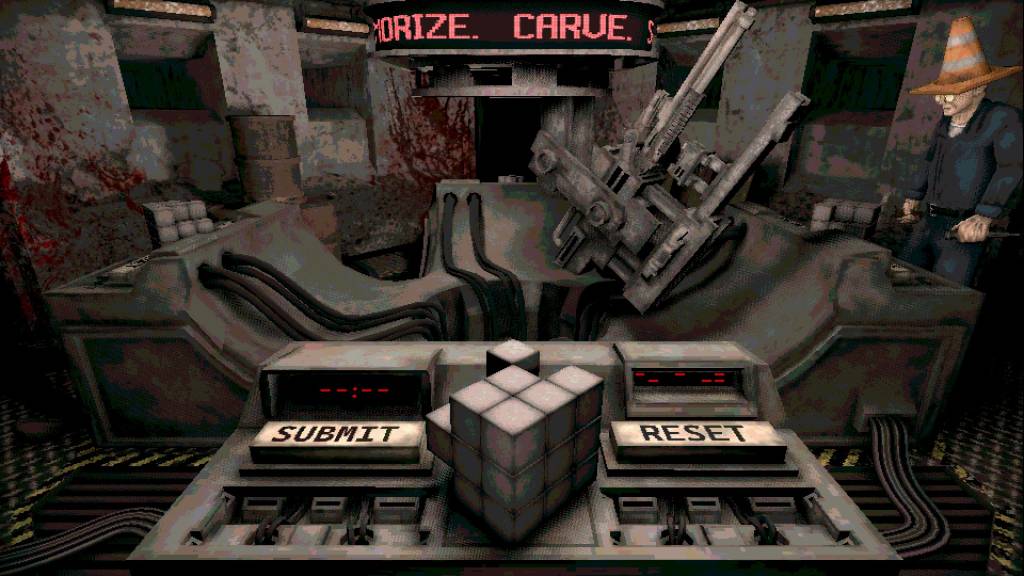
“My friend’s blood splattered onto my beans”
Experienced players have a significant advantage in this game. Take Minefield for example: while I was still clumsily using the detector to scan the red-dotted areas step by step, my friend who played the game before was already racing towards the finish line by following the bloodstains left by those who had been blown up before us. Some players even “cheat” in Chisel Gauntlet by secretly photographing the pattern they are supposed to memorize before carving it.
As the rankings are refreshed after every round, the game gradually begins to feel less like a party and more like a life-or-death examination. No one wants to remain at the bottom, so the bloodshed escalates as the match progresses. The game moves from individual competition to temporary cooperation, before finally collapsing into betrayal. At first, you’re simply focusing on yourself: in a mini-game similar to ‘Red Light, Green Light’, you secretly eat the peas while making sure the host doesn’t notice you moving. Soon, you realize you can cooperate with friends to push the players with the highest score onto the underground tracks. In some mini-games, players can attack each other directly. While your friends crawl through the obstacles, you track them through the scope and show no mercy.
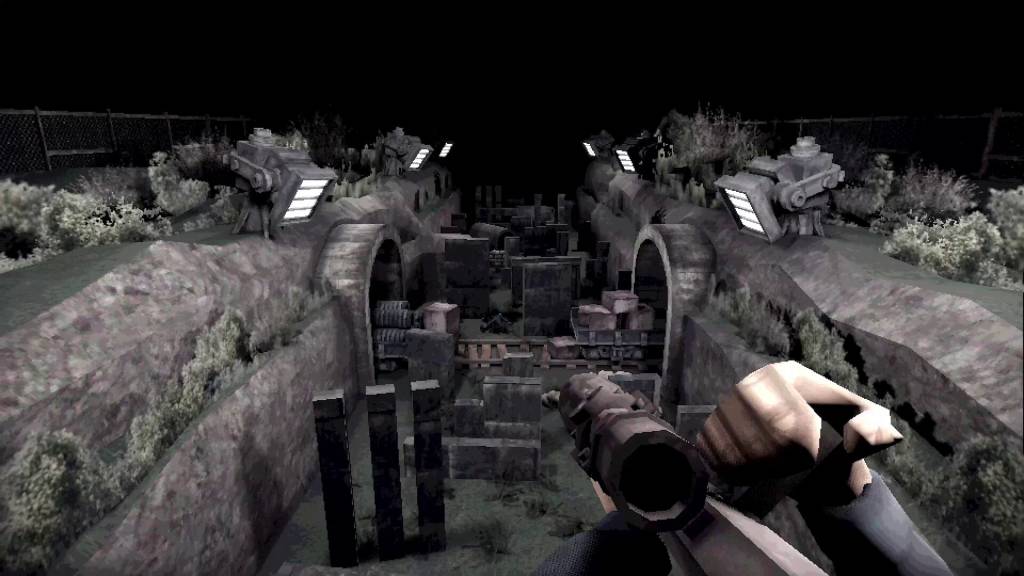
“Something bigger?”
After all the heart-stopping survival and betrayals, the sole survivor is faced with a puzzling conclusion: cold assessments of the player’s performance appear on screen. As the camera panned, a towering, roaring experimental device bearing the names of countless individuals is revealed. This has led many players to draw parallels with Tartarus Engine, another Klubnika game, which mentions that KETAS (the antagonistic corporation in his game universe) has been conducting experiments to simulate reality. So it’s possible that you and your friends were simply thrown into a cruel experiment, and you chose to betray them without a second thought!
Overall, it is a party game well worth trying. Even if you’ve never played this kind of game before, the mechanics are easy to understand, and a full run through the whole game takes roughly 60 minutes. Its true charm lies in the bloody and hilarious cycle of alliances and betrayals.
A final word of advice: look after your friends! You might lose their trust in an hour!
Other Information:
Publisher: Oro Interactive
Developer: Mike Klubnika, GDeavid
Platforms: PC (Steam / Windows / Linux)
Release Date: July 30, 2026
Genres: Action, Indie, Party Game (also Co-op, Multiplayer)
PEGI: N/A
Photos: screenshots from Machine Party (Mike Klubnika and GDeavid, 2026) and Steam, taken by the author