FI-DACH is an international research network dedicated to the study of cultural relations between Finland and the German-speaking countries—Germany, Austria and Switzerland—from both historical and contemporary perspectives. These cultural relations are formed through linguistic, literary, cultural and translational encounters, which connect countries, communities and intellectual traditions across time.
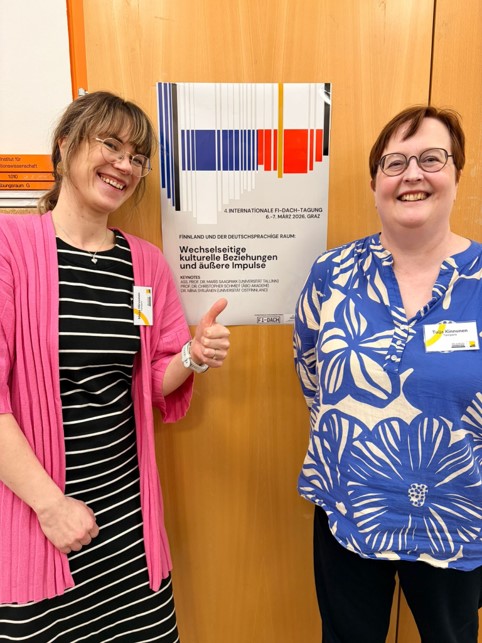
The conference offered a rich programme of keynote lectures and section panels addressing a wide range of topics related to contacts between Finland and German-speaking Europe. One of the keynote speakers was Maris Saagpakk (University of Tallinn). In her keynote, Saagpakk explored connections between Finland and Estonia in the nineteenth century, focusing on the first Estonian translators and on Finnish-language literature as an encouraging model for the development of literature in Estonian. Prior to this period, literary translation in Estonia had usually occurred from German, and translators were primarily Baltic German clergy or members of the educated elite with a German-language education. Saagpakk’s talk highlighted the role of translation in processes of cultural and linguistic emancipation.
Maija Hirvonen presented in her talk interim results from the NewWorkTech project, which she leads and which examines everyday work practices of people with disabilities in Europe, including Germany and Finland. The project engages in research-based enhancement of work-related capacities of both people with disabilities and the general workforce, with particular attention to technologically mediated tasks and interaction. Plural’s researchers Annamari Korhonen and Dorothée Kraus also contribute to the project and have collected a vast amount of video and interview data which are currently being analysed.
Tuija Kinnunen’s presentation discussed the concept of translation awareness, a newly developed notion that she explores in the edited volume Exploring Translation Awareness that will soon appear in Routledge. Besides Kinnunen, its editors are Tanya Escudero from the University of Tallinn and Päivi Kuusi from the University of Helsinki. As a concept, translation awareness comprises an understanding of the functions of translation and translating in society; knowledge of translation processes, the agents involved, the competencies required, and their potential implications; and attitudes towards and beliefs about translation. The audience engaged actively in the discussion and regarded the concept as both timely and necessary, particularly in light of current societal debates on multilingual communication and the role of the multilingual access to information in democracies.
Overall, the range of presentations was broad and offered a stimulating cross-section of topics linking Finland and German-speaking countries. Among the many other timely and interesting contributions at the FI-DACH conference were Claudia Niersten’s paper on the concept of Finnlandisierung (suomettuminen), which examined how the Finnish press responded to the introduction of the term during the 1970s, as well as Christopher M. Schmidt’s keynote on a contrastive study of the discourses about artificial intelligence in German and Finnish mass media. The empirical results in Schmidt’s study indicate that the perceptions of AI are markedly different in Germany and Finland. We look forward to reading the research report once it is published.
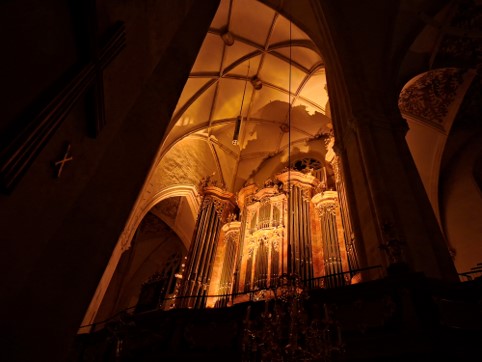
Beyond the conference sessions, the social program enabled lively exchanges of ideas and the forging of new contacts over excellent catering, both between panels and during the conference dinner. The weather was kind to the visitors, and the city of Graz showed itself at its best. We concluded our visit by clearing our minds at the Graz Cathedral, attending a striking concert by experimental musician and artist Maxime Denuc —a memorable and calming end to an intellectually rich conference trip. As we looked up at the high ceiling of the dome and the music permeated us in every possible way, we felt a deep sense of gratitude for the opportunity to take part in inspiring academic discussion, exchange and encounters abroad, to walk new streets, to face new sceneries—and, in the midst of it all, to reflect on eternity and abstract heights thanks to art.
Tuija Kinnunen
Maija Hirvonen