
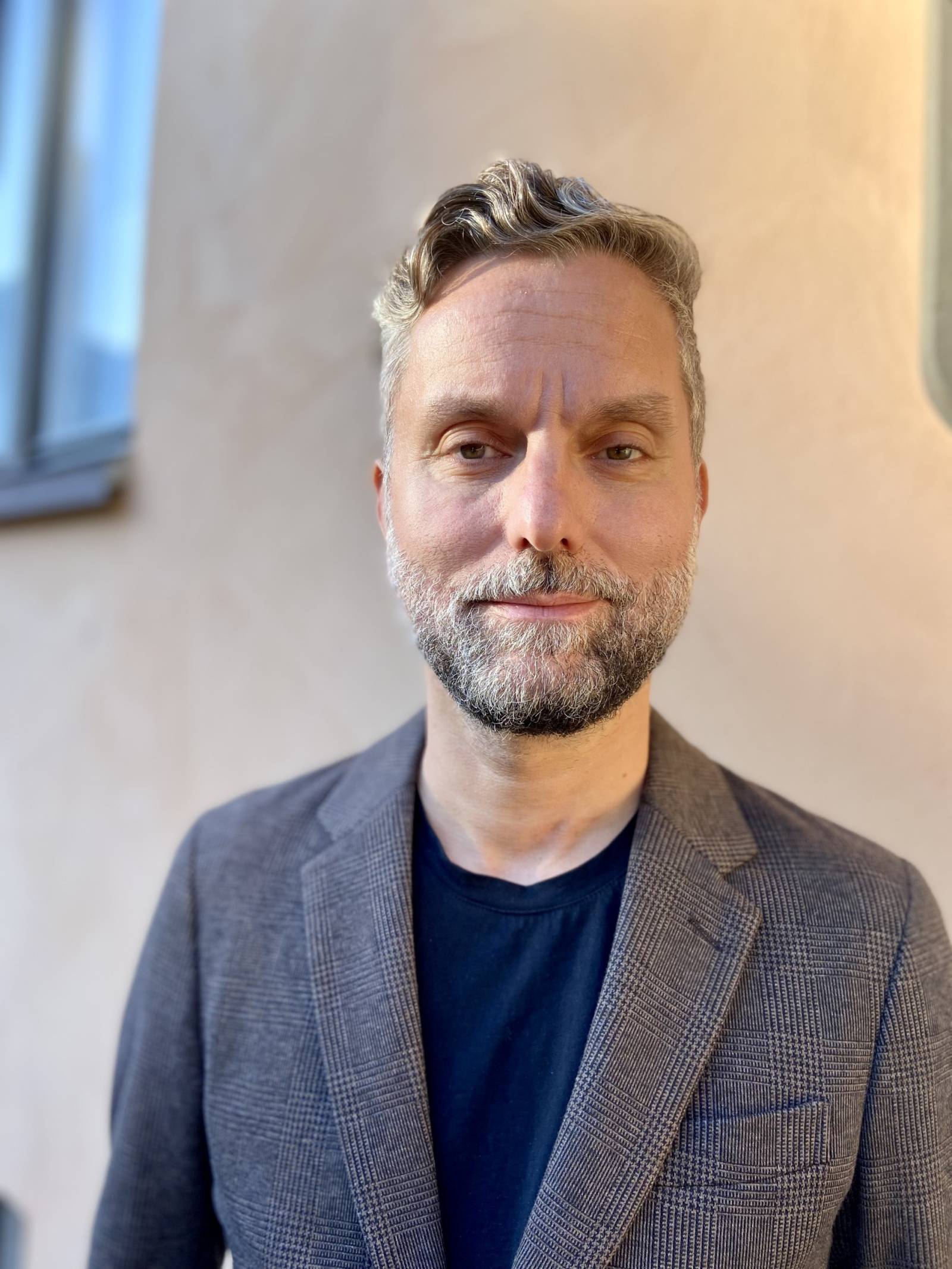
Written by Helmi Marttila
Warmly welcome to Tampere, Raphael! Could you briefly introduce yourself and your research background? What are you working on currently?
I am from Stockholm, Sweden, and I have a PhD in Translation Studies (TS) from Stockholm University. My research is most aptly located within the area of TS now commonly referred to as Cognitive Translation and Interpreting Studies (CTIS). Similarly to a growing number of CTIS researchers – some of whom I’m lucky enough to have as my colleagues at TAU – my primary interest is in how translation processes unfold in authentic workplace settings, and this orientation governs my research methodologically and theoretically. Adopting a socio-cognitive perspective, a central assumption guiding my research is that the cognitive processes of translating are not limited to people’s brain activity but are, to a significant degree, distributed across people, tools, and time.
My current postdoctoral research project Translating Institutional Systems (TRAILS) explores how institutional translation relies on distributed cognition, and examines processes such as remembering, problem solving, and decision making by studying teamwork in institutional translation work. As to empirical setting and data, TRAILS focuses on workplace interaction in the Swedish translation unit at the European Parliament, using video data on naturally occurring workplace interactions as well as digital interaction to examine joint activities in the workplace.
You are visiting Tampere University as a Marie Skłodowska‑Curie Postdoctoral Fellow. According to Postdoctoral Fellowships – Marie Skłodowska-Curie Actions, the objective is to support researchers’ careers and foster excellence in research. The programme targets researchers holding a PhD who wish to carry out their research activities abroad, acquire new skills and develop their careers. These fellowships help researchers gain experience in other countries, disciplines and non-academic sectors.
What attracted you to Marie Skłodowska‑Curie Postdoctoral Fellowship?
MSCA PF clearly provides unparallelled opportunities to develop as a researcher and to significantly improve one’s chances of a future within academia. It also gives you the chance to gain valuable experience from working at a university abroad. The possibility of applying with Tampere University as the host institution was brought to my attention by Maija Hirvonen after she formed part of the examination committee for my doctoral dissertation. The rest, as they say, is history.
What is the application process like?
It is a rather comprehensive application process, with very specific requirements in terms of the content, scope, and form of the information to be provided. What perhaps makes it a bit different from many other applications is that a large part of the application is devoted to a description of the applicants’ current skills and competences as well as their future goals and how they envision that the fellowship will bring them closer to these goals. Luckily, the pre-award team at Tampere University’s research services provides excellent support to applicants, not least in the form of a masterclass where all the sections of the application are thoroughly reviewed. I warmly recommend anyone planning to apply to take part in these preparatory activities.
What has your experience with the MSCA PF been like?
It has been a truly positive and rewarding experience so far, in no small part thanks to the way in which I have been received at Tampere University and the support provided by the university. If anything, it has exceeded my expectations in terms of the opportunities offered by the grant.
You are organising the FIRE-TI conference (International Conference on Field Research on Translation and Interpreting) in March 2027 in Tampere. What is your core motivation for organizing the FIRE-TI conference? How did the idea of organizing it emerge?
The idea of organising a conference emerged during the preparation of my MSCA PF application. It was Maija Hirvonen who specifically suggested that we could aim for a second iteration of the first (and hitherto only) FIRE-TI conference organised in Vienna in 2022. Both Maija and I participated in the first conference, and we agree that it was a truly great initiative that deserves to be revisited. Because of the pandemic, the first conference was postponed and, in the end, held online, so it will be very exciting to gather the participants to FIRE-TI 2 face to face here at TAU. Also, TAU is quite the obvious choice for a conference with this focus, given the pioneering work in field research done here by Kaisa Koskinen, among others.
What are your expectations for the FIRE-TI conference? What are you most excited about?
Unsurprisingly, I have high expectations for the conference. Just to mention one thing, we have really interesting plenaries to look forward to. I think I’m most excited about the opportunity to gather a community of researchers from different parts of the world and from different areas within translation and interpreting studies, who all share a common interest in cross-language communication in real-life settings and situations.
The FIRE-TI conference invites a broad range of contributions on empirical, conceptual, and methodological aspects of field research on translation and interpreting in their many different shades.
The call for papers for the conference is now open, and you can find it and all other information in the conference website: https://events.tuni.fi/fireti2027/ See you at FIRE-TI!