Nice question, eh? It’s exactly what the Research Council of Finland is asking when you apply for an Academy Research Fellowship, and of course other funding organizations are asking the same.
When you really get to thinking about it, though, the question is downright daunting. I faced it last fall when I applied for external funding for the first time. And I lived to tell the tale.
Question: The results of that funding round are coming out in a few weeks. Why don’t you wait for that before writing about it?
Answer: a) I wanted to write about the process of applying, not the process of getting rejected. Because b) according to statistics, I have an 85% chance of getting rejected.
The first mental block I had to applying was the enormity of the whole funding thing. For a year I dabbled with the idea. I went to some info sessions, but couldn’t commit to jumping full-throttle into writing multiple applications. What clinched the deal was my supervisor, Kaisa Koskinen, who advised me to pick one and focus on that. She asked me a simple question: which one best matches what you want and what would work for your own ideas?
That led to the first challenge: what do I want? With years of management behind me in past careers, the most logical choice would be to propose or jump into a big project. But I realized that at this point in my life, I don’t want that. I want to do research, not have a full-time management job. I chose the Research Academy of Finland’s Academy Research Fellowship, which focuses on small or even individual projects.
Then I sat down to the next challenge: what are my own ideas? We’re talking, like, visionary stuff here – that is basically what they’re asking you to be in these things. If I give you a million euros, what would you do with it that would advance your little part of the research world? Based on your expertise, what are the most important things for the future and what should be done next?
Again, daunting.
I know some things about myself and one of them is that I am no visionary. I would really have to crank up the cognitive load on that one.
The first step was internalizing the Research Academy’s idea that the fellowship is meant to be a personal one, focused on the ideas of individual researchers. I specifically chose to stick to my own pure (dare I call it this?!) vision instead of trying to put together a collection of the best ideas of myself and others. I did not envision who the others in my small project might be or what kinds of competences they’d have, but rather painted my own picture of what I thought was needed. I then talked to potential collaborators about my picture and eventually hammered out a project idea.
Question: In the midst of all of this, did you ever get doubtful about the time you were putting into it vs. that 85% chance of rejection?
Answer: Absolutely! But our university has been crystal clear on the topic: we should be applying for funding; it’s part of our jobs. The beauty of that is that it shifts the responsibility of doubting off of your own shoulders and lets you focus.
Overall, I was pleasantly surprised by the process. It was not the all-encompassing frenzy I imagined but rather a steady workflow. Several things helped:
First, the support given by the university’s pre-award team was top-notch. I have no idea how people got through these things back when they had to figure it all out for themselves. The team provided a number of very useful info sessions, feedback channels, and a few deadlines that divided the process into digestible pieces.
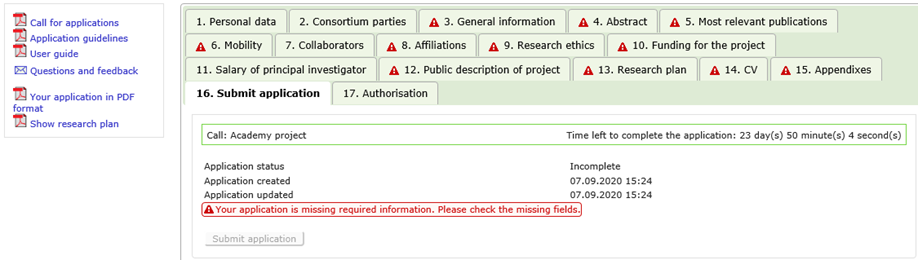
Second, the Academy also does a good job of breaking the application process down into discrete tasks. The following picture shows the application portal user interface, in which the tabs with a red triangle mark uncompleted things.
Finally, my supervisor’s support and insistence that the application work be put into my work plan were key – I guess we always need to make sure our efforts show there. And the collegial support organized through the Plural research centre was very useful.
Question: So what’s your impression of the process? What did you get out of it, especially considering your probable rejection?
Answer: It was a positive experience that I recommend to others. It’s useful to be forced to step away from the nitty-gritty of your research and look at the big picture once in a while. It helps to crystallize what you’re doing, why, and what you should be doing next.
I ended up agreeing with something I heard multiple times in those info sessions: applying for funding is doing research.
Author: Mary Nurminen