
DPLA takes part in an international network of doctoral programmes in Translation Studies, Doctoral and Teacher-Training Translation Studies Summer School (DOTTSS). Other members of the network are University of Ljubljana (Slovenia), University of Turku (Finland), University of Granada (Spain) and Boğaziçi University (Turkey). Every year, one of the partner institutions hosts a two-week summer school for doctoral researchers in Translation Studies.
The teaching is provided by lecturers and professors from the partner universities, together with an invited guest professor. Participants are mainly doctoral students from the partner programmes, although a limited number of external applicants can also join the programme.
In one of our previous blog posts, we reported on the DOTTSS Summer School 2025, which took place in Istanbul (https://blogs.tuni.fi/plural/a-researchers-life/pluralists-represent-tampere-university-at-translation-studies-summer-school-in-istanbul/). In 2026, it was Granada’s turn to host the event.
This year, quite expectedly, most participants came from the Universities of Granada and Ljubljana. There were also three students from outside the network: one each from Italy, Germany, and the United States. Unfortunately, there were no student participants from Finland this time.
Most of the teaching was provided by colleagues from the University of Granada, although all partner universities contributed to the programme. Tampere University was represented by Mikhail Mikhailov (week 1), Sari Hokkanen (week 2) and Kaisa Koskinen (week 2, online). The invited guest professor was Julie Boéri from the University of Manchester.
The programme covered a wide range of topics in Translation Studies, rather than focusing on a single theme. This made sense, as the doctoral researchers had highly diverse research interests.
Some sessions focused on practical aspects of academic life, such as building an academic career, publishing research articles, and working in translator training. Others introduced participants to ongoing research projects and emerging developments in the field. The lectures given by visiting professor Boéri presented her research in activist interpreting and in the ethics and politics of translation. The lectures covered both theoretical and methodological questions but also the practical experiences she has had in doing transdisciplinary work between research and the arts.
An especially valuable part of the programme was the tutorial system. After the lectures, students could book individual consultations with the lecturers and receive feedback on their research, publication plans, or career goals. These one-to-one discussions were arguably the most beneficial part of the summer school.
On the final day, it was the students’ turn to take the stage. A small student conference was organized, where participants presented their research projects and received comments from both fellow students and senior scholars. It provided valuable experience of academic conferences to students just having started their doctoral work as well as an opportunity to receive feedback on more advanced projects.
Classes were held in the Faculty of Translation & Interpreting’s historic Palacio de las Columnas (“Palace of Columns”), a beautiful building with an elegant façade and a picturesque courtyard with orange trees and a small water pool covered with water lilies.
The main challenge was the lack of air conditioning. Because the building is protected as a historical monument, installing cooling system wasn’t possible. With temperatures well above +30°C, both lecturers and students had to rely on fans and open windows. The downside was the constant noise from the street, which occasionally competed with the lecturers for the audience’s attention. Fortunately, the friendly and relaxed atmosphere more than compensated for these minor inconveniences. During the second week, as the outside temperatures remained above +40°C, the organizers were able to find an air-conditioned seminar room in another university building down the corner.
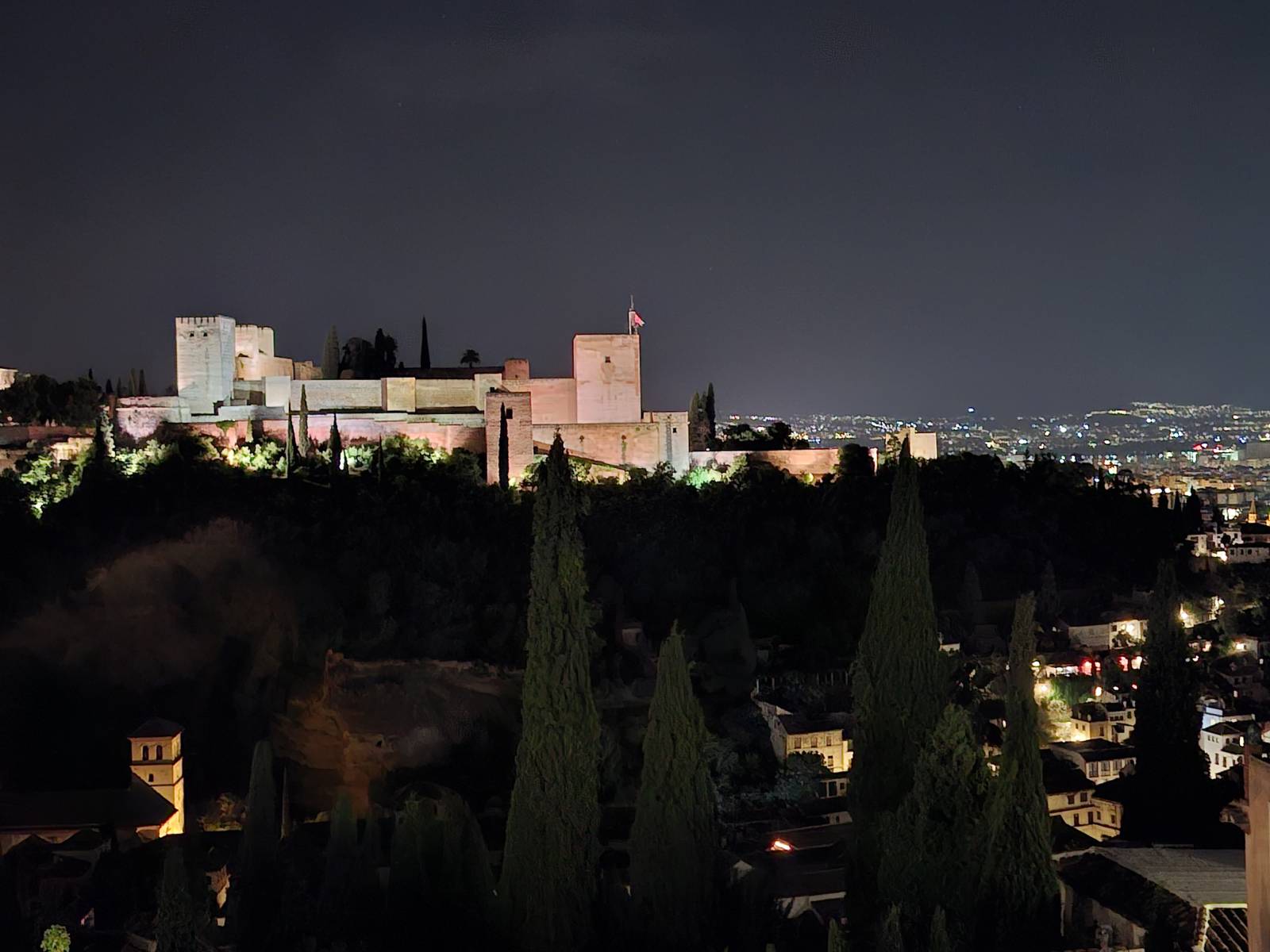
Granada itself was an excellent setting for the summer school. The city combines a rich history with an extraordinary concentration of cultural attractions, many of them just a short walk from the venue. Participants could visit the Cathedral and Royal Chapel, explore the world-famous Alhambra, wander through the historic Albaicín district, or climb the hill of Sacromonte. In the second week of the summer school, the organisers arranged a historical walking tour that allowed us to get to know the history of the university and visit some of its oldest buildings in the city center.
The social programme of the summer school also included a lovely get-together on the hills overlooking Alhambra, in Carmen de la Victoria, a historical garden house and residence owned by the university. Despite the intensive academic programme, there was always time to unwind after classes and enjoy the unique atmosphere of Andalucia. This atmosphere was remarkably warm even after sunset. During the DOTTSS school, nighttime temperatures rarely fell below 25°C, making evening walks through Granada as memorable as the academic discussions that took place during the day.
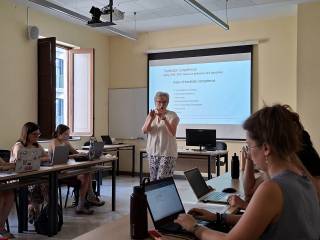
Prof. Dorothy Kelly giving her lecture.