
A framework for human-centered robot communication
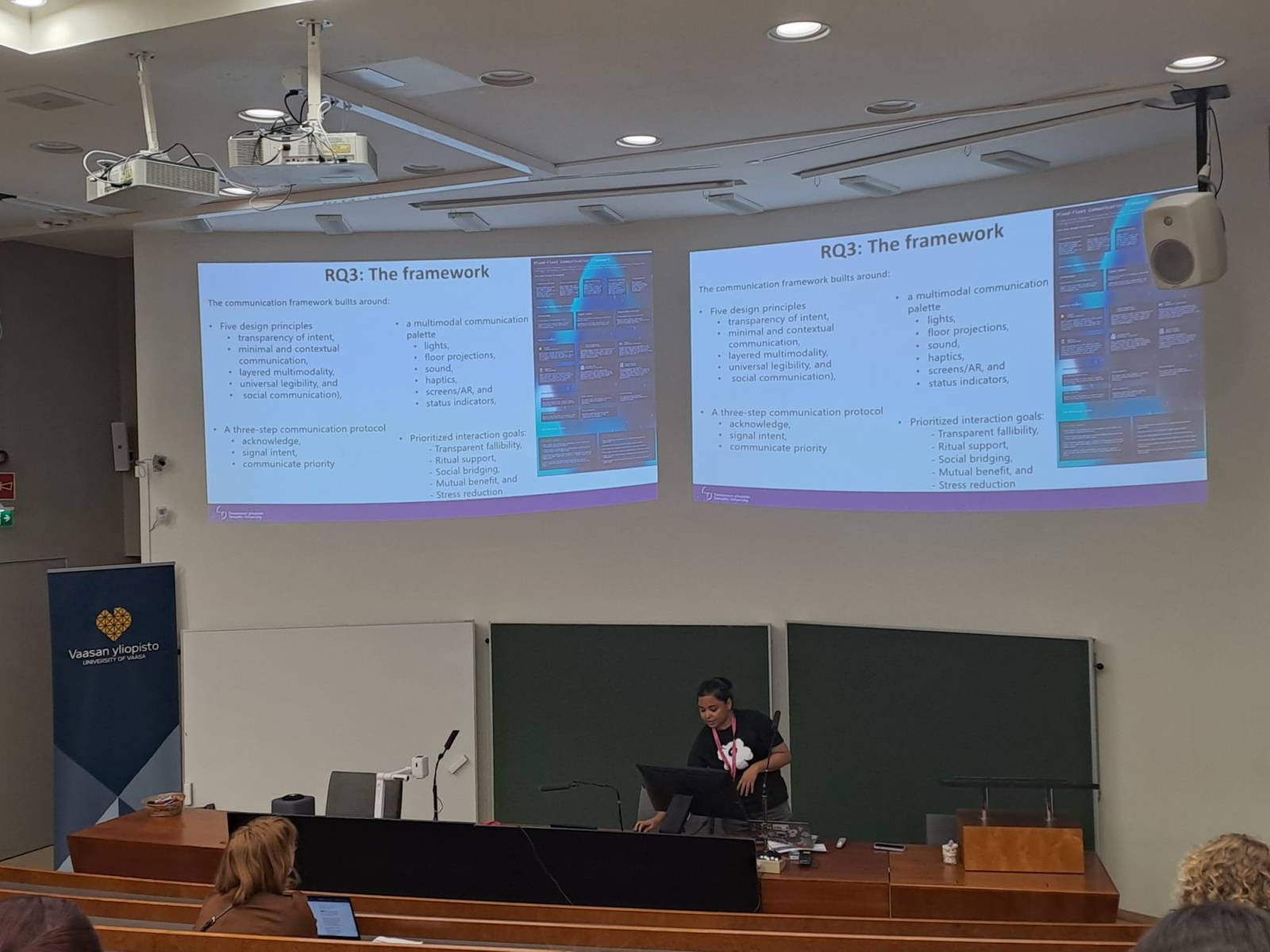
At NordiCHI 2026, I had the opportunity to present our paper, “A Human-Centered Communication Framework for Mixed-Fleet Warehouse Environments.” This work was carried out in wp1 as part of the Mixed Fleet project, funded by Business Finland. Our work explores how human workers and automated guided vehicles (AGVs) can communicate more effectively when sharing warehouse spaces. While human drivers often rely on eye contact, gestures, and subtle social cues to coordinate their actions, AGVs lack many of these familiar ways of communicating. Through our research, we developed a framework that brings together five design principles, a range of communication modalities, and a three-step protocol: acknowledge, signal intent, and communicate priority. The goal is to help designers create machine interactions that are clearer, more predictable, and better suited to the needs of workers. Presenting the work was a valuable opportunity to share our findings with the HCI community and reflect on how we can make human–machine collaboration more human-centered. The full article can be found here: A Human-Centered Communication Framework for Mixed-Fleet Warehouse Environments | Proceedings of the 14th Nordic Conference on Human-Computer Interaction
A pleasant conference, with a question about diversity
Overall, NordiCHI was a pleasant conference experience, offering the opportunity to meet colleagues from different countries, exchange ideas, and learn about ongoing research across the HCI community. At the same time, I noticed that AI was a dominant theme across many presentations, including topics where I wondered whether AI was necessarily needed to address the research question. This left me thinking: Is everyone exploring AI these days, and how does this growing focus influence the kinds of research that are submitted and accepted? NordiCHI has traditionally been a space for the broad field of human–computer interaction, encompassing many perspectives on people, technology, design, and everyday experiences. While AI is undoubtedly an important area of research, I found myself missing some of the diversity of topics that makes HCI so rich. I left the conference with new connections and ideas, but also with a question for our community: How can we embrace the opportunities offered by AI while continuing to make room for the full diversity of questions, methods, and perspectives within HCI?
Written by Aparajita Chowdhury from Mixed Fleet project