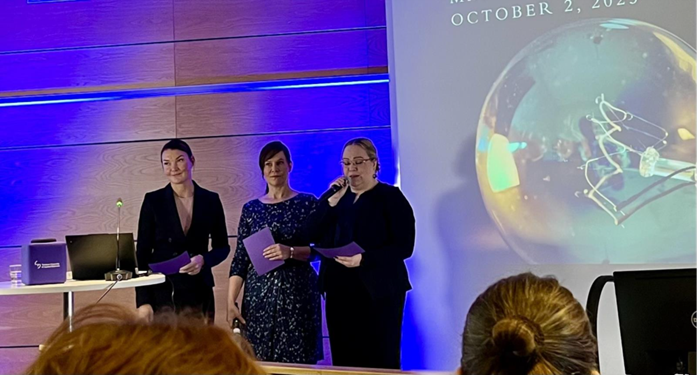
For us students, the event offered a valuable opportunity to join the discussion and reflect on what it means to be human in the age of artificial intelligence. Popularizing science is an essential part of the educational mission of universities of applied sciences – meanwhile providing students with tools for critical thinking, information evaluation and building their own professional expertise.
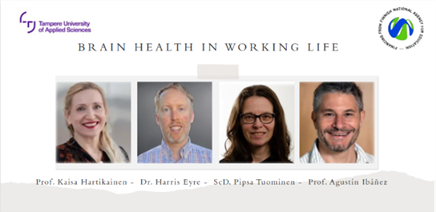
The event’s keynote speaker, Professor Kaisa Hartikainen from the University of Helsinki, took the stage to explore the questions of brain health in working life transformed by technology. She offered insights into brain structure, measurable mechanisms of burnout, affective ergonomics and the vital
role of sleep – particularly the concept of Sleep Capital. Hartikainen’s presentation set the stage for other leading experts.
Dr. Harris A. Eyre discussed the role of neuroeconomics in the ongoing transformation of work and the development of cognitive capability, while TAMK’s very own Pipsa Tuominen brought in a sports medicine perspective. She emphasized the importance of physical activity and recovery for cognitive
performance. Rounding out the program, professor Agustín Ibáñez one of Latin America’s foremost brain health researchers, outlined the direction of a Finnish-Chilean collaboration aimed at advancing global equality in brain health.
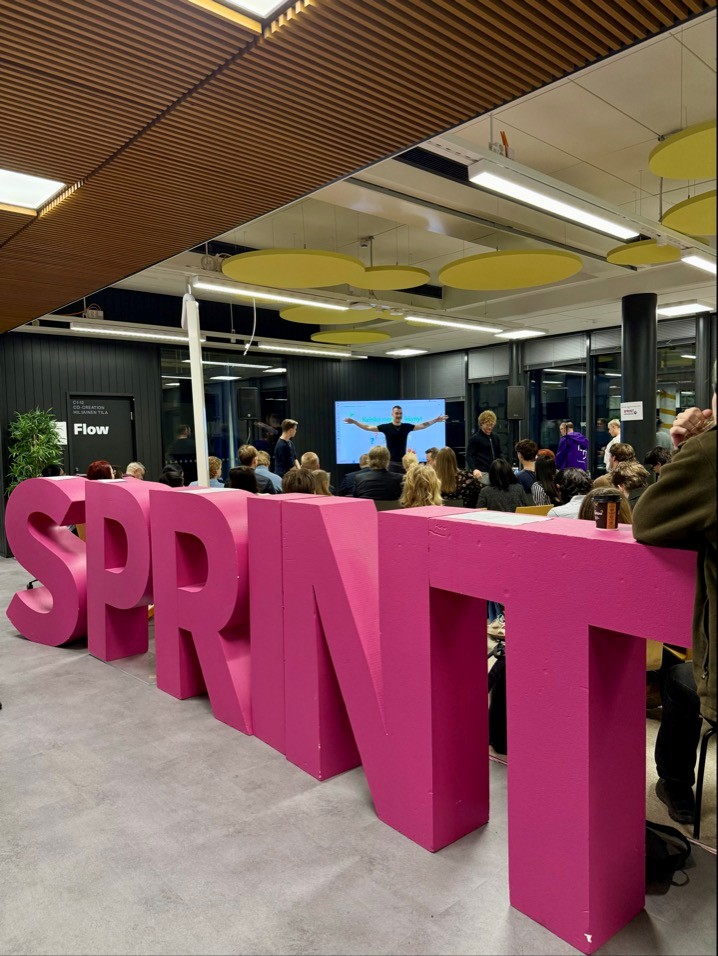
The invisible work behind the scenes. The Masters’ Conference was more than just an event for us students. It was a new learning environment where theory met practice. As master’s students at TAMK, we took part in organizing everything from access control to LinkedIn visibility, from writing the Yle Areena presentation text to preparing speaker introductions and attending budget meetings. The lecturers’ pedagogical aim was to give students access to systems, decision-making and backstage discussions – not only as observers, but as active contributors.
TAMK’s way of working – and more broadly, the Finnish educational culture – can sometimes surprise international partners with its boldness and agility. For students, the conference offered an opportunity to develop skills in project management, communication and public speaking – those
uniquely human strengths that cannot be outsourced to artificial intelligence. At the same time, it deepened our understanding of how brain health, technological development and human expertise are interconnected in the future of working life.
The power of meaning. To quote Professor Hartikainen: When we challenge ourselves with demanding tasks in different areas, we experience the greatest growth – almost as if we were training at a gym for the brain. However, this development only occurs when recovery is active.
Recovery is not just about taking breaks; it is laughter, connection, social engagement, and meaningful activity. Just like now. For us, this was not merely event planning. It was a launchpad for building and harnessing brain capital.