
Where History and Resilience Meet
Much of the success of my visit was thanks to my excellent host, Salim Murad. Salim guided international students through different parts of historic Prague, giving them tasks that required slow, deliberate thinking. At Salm Palace and the Náprstek Museum, we saw how history, urban environments and learning can be brought together. During a visit to a synagogue, we witnessed the horrors that systematic terror can produce. The names of nearly 80,000 Holocaust victims are handwritten on the walls of the Pinkas Synagogue.
I delivered the opening speech at the international student conference of the EMMIR Master’s program, held at the EU’s Europa Experience Center. The venue featured a 360-degree presentation space, with the European Parliament’s plenary chamber projected onto the surrounding walls. My presentation was titled From Emigration to Immigration: The Finnish Story of Identity, Security and Belonging. I discussed Finland’s migration history and the integration of immigrants.
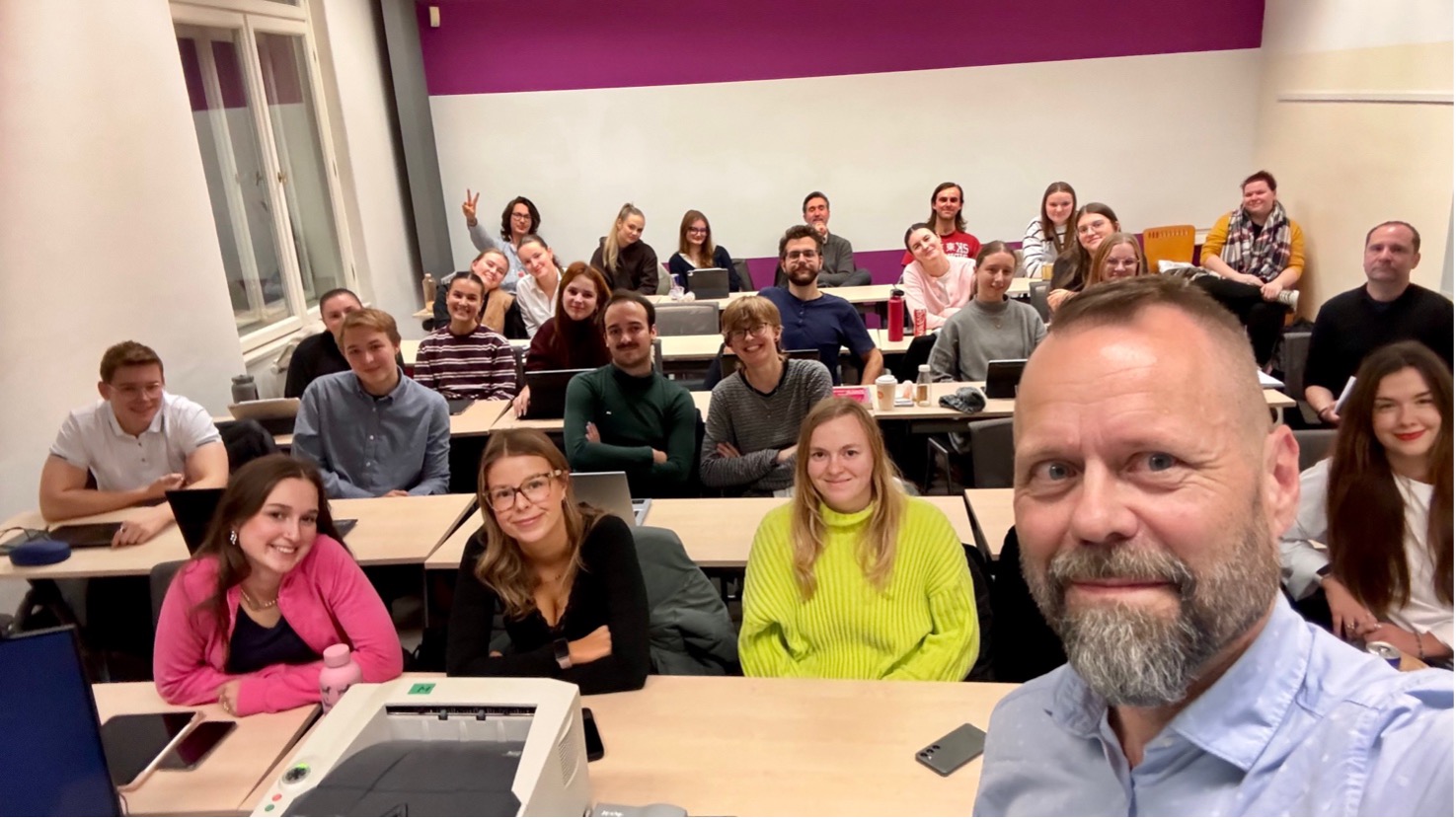
Later, I facilitated a discussion on resilience with future teachers, titled Are We Becoming Less Resilient? What a 12-Minute Run Can Tell Us About Society. The discussion was sparked by the story of my grandfather, who defended Finland’s independence against the Soviet invasion during the Winter War. We explored what the declining Cooper test results of Finnish military conscripts might tell us about societal change, and how we can strengthen physical, psychological, social and ethical capacities. Following a lively discussion, we concluded that responsibility for maintaining resilience lies with individuals, communities and society as a whole.
International Networks and New Opportunities for Collaboration
I also met representatives of several non-governmental organisations (NGOs). At the historic Café Louvre, once frequented by Franz Kafka and Albert Einstein, I discussed disinformation, critical thinking and the role of civil society in security with Veronika Víchová and Jan Paťawa. Towards the end of the week, I met Bohdan Rajčinec, President of the European Congress of Ukrainians. I introduced TAMK’s SAFE Research Group and our collaboration with Ukraine. NGOs also play an important role in international research and development projects.
At the Charles University Resilience Centre, I met its director, Jan Tesárek. The centre works to strengthen the university community’s capacity to cope with crises and challenging situations. We discussed what higher education institutions can learn from each other and how preparedness could be studied. I presented an emerging project concept for the EU’s Horizon Europe programme, combining digital crisis simulations with practical exercises in educational institutions.
The visit opened several potential avenues for collaboration. There is no confirmed funding or established project yet. However, we now have a much clearer picture of the partners with whom we could bring together research, education and practical crisis preparedness training.
Are you interested in research and development projects focusing on resilience and security? Would you like to contribute to building international collaboration in these fields? Get in touch.
Author: Ilkka Piiroinen, Senior Lecturer, Social Services and Health Care, Tampere University of Applied Sciences (TAMK), SAFE Research Group